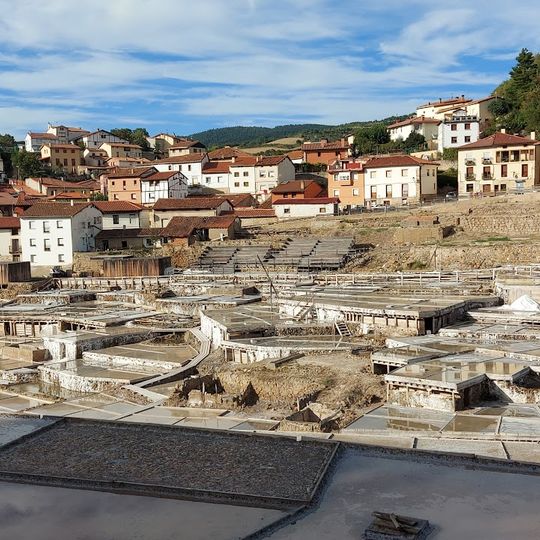
Valle Salado, Historic salt evaporation ponds in Añana valley, Basque Country, Spain.
The Valle Salado de Añana is an inland salt works where brine from four springs at the head of the valley is led into shallow ponds called eras and left to evaporate in the sun and wind. The ponds are built on stepped terraces with stone walls and wooden frames, and the brine emerges with a salinity above 250 grams per litre.
Salt has been extracted at Añana for over 7,000 years, the oldest working salt works known. Neolithic producers boiled brine in ceramic pots; around the 1st century BC, with Roman rule, sun-and-wind evaporation ponds replaced heating. The Roman town of Salionca, cited by Ptolemy, controlled and distributed the salt until its destruction in the late 5th century.
Salt from the valley was controlled by the Crown from 1564, when Philip II imposed a monopoly with strict production rules; the monopoly ended in 1869 and control returned to local owners. In 2017 the FAO listed the valley as a Globally Important Agricultural Heritage System. The settlement beside the ponds was granted town status in 1140.
Guided tours operate year-round through the visitor center, which provides detailed information about production processes, opening hours, and educational activities suitable for families and researchers interested in traditional salt harvesting methods.
Four natural saline springs emerge due to a geological phenomenon called diapir, creating brine with salt concentration exceeding 250 grams per liter, significantly higher than Atlantic Ocean water and enabling continuous salt extraction.
The community of curious travelers
AroundUs brings together thousands of curated places, local tips, and hidden gems, enriched daily by 93,455 contributors worldwide.


