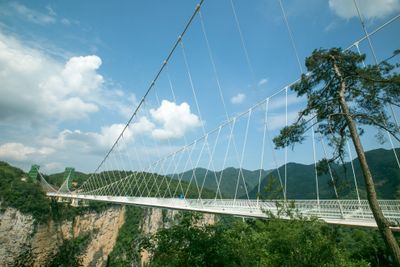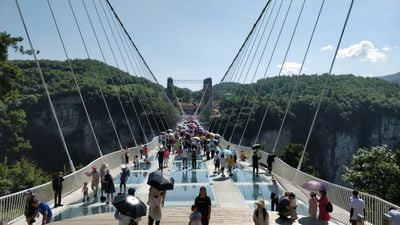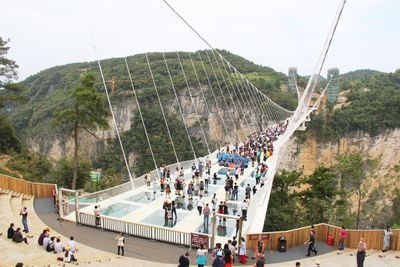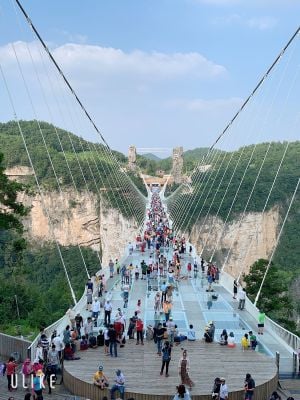
Zhangjiajie Glass Bridge, Glass footbridge in Zhangjiajie National Forest Park, China.
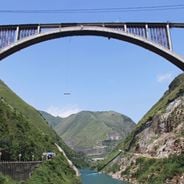
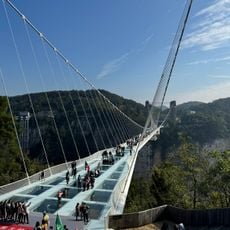
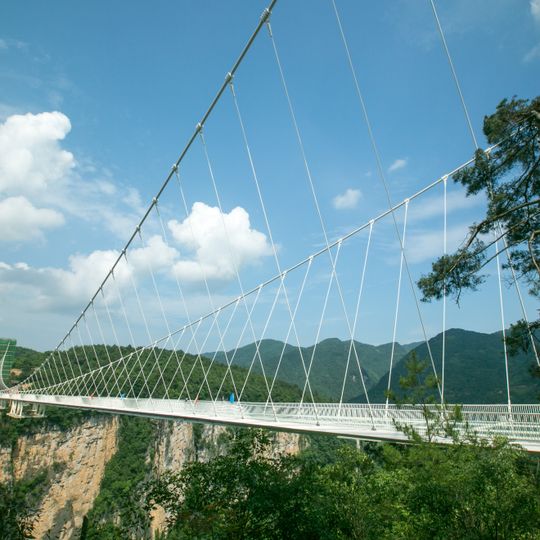
The Zhangjiajie Glass Bridge is a suspension footbridge made of transparent glass that spans a deep valley in Hunan province, connecting two rock faces 300 meters above the floor below. The structure measures 430 meters in length and 6 meters in width, with a walking surface composed entirely of see-through glass panels that allow views straight down into the gorge.
Israeli architect Haim Dotan designed the construction, which opened in August 2016 as the longest glass-bottomed pedestrian bridge in the world. Since its completion, the structure has undergone several technical adjustments to safely manage daily visitor flow and maintain structural stability during changing weather conditions.
The local name Yuntiandu evokes the image of a silk path suspended among mountain peaks, and many visitors pause mid-crossing to gaze downward, reflecting on the connection between human engineering and the natural gorge below. This bridge embodies a modern interpretation of ancient Chinese concepts linking pathways through clouds to journeys between earth and sky, a theme that appears often in regional storytelling and poetry.
The bridge opens daily between 09:00 and 15:30, and visitors must book tickets in advance and present valid identification before entering the facility. The walking surface can become slippery in rain, so shoe covers are often provided at the entrance to prevent falls and protect the glass surface.
The entire construction consists of 120 individual glass panels, each measuring 5.1 centimeters in thickness and containing multiple layers for safety. Beneath the bridge lies a bungee jumping platform that drops 285 meters into the depths, making it one of the highest of its kind in Asia.
Location: Hunan
Architects: Ḥayim Dotan
Official opening: August 20, 2016
Length: 430 m
Longest Span: 430 m
Width: 6 m
Part of: Zhangjiajie Grand Canyon
Address: China, 湖南省张家界市武陵源区9MXW+7FP 邮政编码: 427234
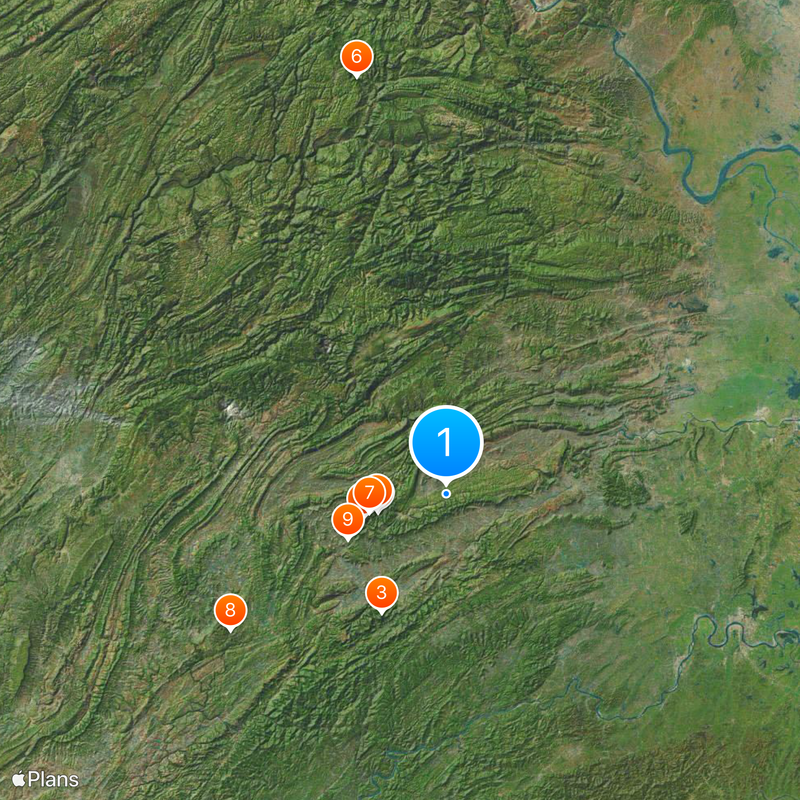
GPS coordinates: 29.39870,110.69820
Latest update: December 4, 2025 23:43
Bridges are a part of our daily lives. They have connected banks, valleys, and communities for centuries. This collection presents structures from various periods and regions. From medieval stone arches to modern steel constructions, these works demonstrate the evolution of engineering. The Rialto Bridge from the 16th century in Venice spans the Grand Canal with a single stone arch. The Golden Gate in San Francisco stretches over 1.7 miles (2.7 km), linking the city to northern California. In Singapore, the Helix Bridge forms a pedestrian link in Marina Bay with its double-helix structure. These structures serve practical purposes in urban transportation while shaping city skylines. They provide technical solutions to geographical barriers and reflect different approaches to bridge construction through the ages.
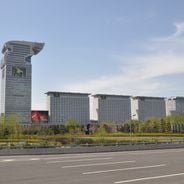
Chinese architecture spans modern skyscrapers, historic fortifications, and technical structures. From the glass bridge in Longtan Valley to the Canton Tower, these buildings combine tradition and modern technology. Temples, fortresses, and museums tell the country's history, while newer structures like the Tianjin Binhai Library and the Beijing National Stadium represent contemporary development. The collection includes examples from different regions across China. In Beijing stand the Phoenix Center, the National Stadium, and the Pangu Plaza. Shanghai houses the Oriental Pearl Tower and Nanjing Road. In Jiangsu Province, the Danyang-Kunshan Bridge extends for 102 miles (164 kilometers). The Canton Tower in Guangzhou reaches a height of 1,970 feet (600 meters). Historic sites complement the modern structures. The Xi'an City Wall in Shaanxi dates from the Ming Dynasty. The Ancient Town of Pingyao in Shanxi preserves traditional architecture from several centuries. The Leshan Giant Buddha in Sichuan was carved into a cliff face during the 8th century. The Wenchuan Earthquake Museum documents the 2008 natural disaster.
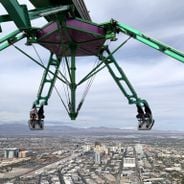
This collection gathers sites where architecture and nature combine to offer extraordinary experiences. From urban observation platforms to natural geological formations, these destinations allow observing the world from remarkable viewpoints. Each location presents a different approach to altitude, whether through modern installations or natural sites. Among the destinations are TILT Chicago, a platform that tilts above the city from the 94th floor, and Trolltunga in Norway, a rocky formation protruding 700 meters above Lake Ringedalsvatnet. In China, the Zhangjiajie glass bridge spans 430 meters between two cliffs, while in Ecuador, the Banos swing enables swinging facing the Tungurahua volcano. Other sites like the Grand Canyon Skywalk in Arizona, the Royal Gorge suspension bridge in Colorado, or the Hanging Temple in Datong showcase the diversity of these places. These destinations are aimed at travelers seeking different sensations and wishing to discover panoramas from unusual positions. Some sites require good physical condition, others are accessible to all. It is advisable to check access conditions and consider your tolerance for heights before planning your visit.
This collection brings together some of the most technically ambitious structures ever built, from record-breaking skyscrapers and suspension bridges to high-speed roller coasters that push the boundaries of what steel and concrete can achieve. These sites span continents and represent decades of engineering progress, offering visitors a chance to experience human innovation at heights and speeds that were once impossible. Whether you're standing on the observation deck of the Burj Khalifa in Dubai, walking across the glass floor panels of the CN Tower in Toronto, or racing through the launch sequence of Kingda Ka in New Jersey, each structure tells a story of technical ambition and problem-solving. The collection includes landmarks like the 324-meter Eiffel Tower in Paris, completed for the 1889 World Exhibition, and modern marvels such as Tokyo Skytree, which rises 634 meters above the city. You'll find the Millau Viaduct spanning the Tarn River valley in France at a height of 336 meters (1,100 feet), the tilted medieval bell tower in Pisa leaning at a 3.97-degree angle, and Russia's SkyBridge suspended between mountain peaks at 2,320 meters (7,600 feet) elevation. These places attract millions of visitors each year, offering not just views and thrills but a firsthand understanding of what modern engineering can accomplish when designers set out to build something exceptional.
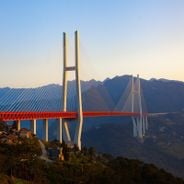
This collection presents the tallest bridges on Earth, measured by their clearance height above the ground or water below. Most of these structures are located in China, spanning deep gorges and river valleys across the provinces of Guizhou, Yunnan, Hubei, and Sichuan. The designs employ various construction methods including suspension bridges, cable-stayed bridges, and arch bridges. The collection also features notable high bridges in Mexico, India, and Papua New Guinea. These structures demonstrate how modern engineering overcomes difficult mountainous terrain and creates new transportation links. The bridges serve as critical infrastructure for regions previously separated by natural barriers.
This collection gathers bridges that hold world records for span length, defined as the distance between two main pylons. While the longest bridge in the world measures 165 kilometers in China, this refers to the maximum span covered in one continuous structure. These constructions demonstrate engineering achievements in crossing maritime straits, rivers, or valleys without intermediate supports. The Çanakkale Bridge in Turkey crosses the Dardanelles Strait with a span of 2,023 meters, setting the current record for suspension bridges. In Japan, the Akashi Strait Bridge connects Kobe to Awaji Island with a central span of 1,991 meters. In China, several bridges exceed 1,600 meters in span, such as the Yangsigang Bridge over the Yangtze in Wuhan or the Xihoumen Bridge in the Zhoushan Archipelago. South Korea with the Yi Sun-sin Bridge, Denmark with the Great Belt Bridge, and Turkey with the Osman Gazi Bridge complete this list of remarkable structures. These bridges are interesting destinations for observing modern civil engineering accomplishments. They connect cities and regions, significantly reducing travel times while offering scenic views of the landscapes they cross. Visiting them allows appreciation of the scope of work involved in constructing these infrastructures under often challenging conditions.
Zhangjiajie National Forest Park
28.5 km
Tianmen Mountain
44.3 km
Wulingyuan
23.2 km
Bailong Elevator
23.5 km
Sidu River Bridge
139.2 km
Avatar Hallelujah Mountain
26 km
Tusi Sites
83.9 km
Huanglong Cave
35.4 km
Chengtoushan
98.3 km
Qing River
130 km
Laosicheng
83.6 km
Lishui River Bridge
53.1 km
Hongze Lake Levee
139 km
Zhijinghe River Bridge
144.9 km
Red Stones Forest
111.2 km
Xizhou Tongzhu
103.6 km
Zhicheng Yangtze River Bridge
127.1 km
忠建河大桥
137 km
Puguang Temple
36.7 km
Yidu Yangtze River Bridge
137.5 km
Zhangjiajie Grand Canyon
290 m
Tianmen Mountain Cable Car
44.4 km
Puguang Temple
19.9 km
Chaibuxi Grand Canyon Scenic Spot
93.7 km
Longtanhe Bridge
137.3 km
Weijiazhou Bridge
136.9 km
Qingjiang Gallery
126.9 km
Chexi
145.2 kmVisited this place? Tap the stars to rate it and share your experience / photos with the community! Try now! You can cancel it anytime.
Discover hidden gems everywhere you go!
From secret cafés to breathtaking viewpoints, skip the crowded tourist spots and find places that match your style. Our app makes it easy with voice search, smart filtering, route optimization, and insider tips from travelers worldwide. Download now for the complete mobile experience.
A unique approach to discovering new places❞
— Le Figaro
All the places worth exploring❞
— France Info
A tailor-made excursion in just a few clicks❞
— 20 Minutes