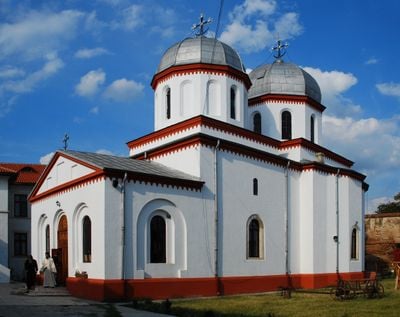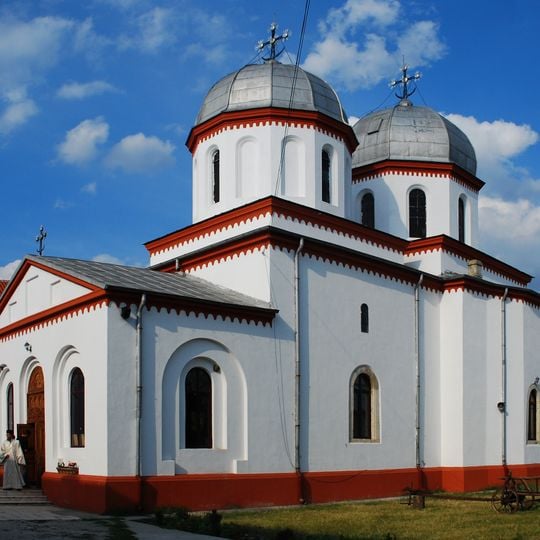
Comana Monastery, Medieval monastery in Comana, Romania
Comana Monastery is a monastic complex in Giurgiu County situated on former marshland, protected by stone walls with five defensive towers arranged in an irregular quadrilateral layout. The grounds include additional structures built over time, including a mausoleum constructed in the early 20th century.
Vlad Țepeș founded Comana in 1461 as a monastery-fortress; it lay ruined by the end of the 16th century. In 1588–1589 the boyar Radu Șerban rebuilt it on the old ruins, reusing the precinct wall, and in 1609, as prince, had the church painted with his princely insignia. Șerban Cantacuzino restored it in 1699–1703, adding cells and the north-side gallery whose ten stone columns carry the double-headed eagle of the Cantacuzini.
The name Comana comes from the surrounding Comana marsh, where the monastery once stood on an island reached by a wooden bridge. In 1699 Șerban Cantacuzino replaced the old dedicatory inscription above the entrance with one naming his great-grandfather Radu Șerban as first founder. The church became the burial place of the Cantacuzino family, and a common grave slab was laid after 1640 for the remains of Anca and Elina.
Visiting is best done on foot, allowing you to walk around the walls and explore the different areas of the grounds. Access is reasonably straightforward, though roads in the area are not always well developed.
In the 1970s, archaeologists working on the monastery grounds found a headless body; historian Constantin Rezachevici and others suggest it may be Vlad Țepeș, buried near the battlefield where he was killed. The foundation of Vlad's original 1461 monastery was rediscovered in 1861 by Ioan Brezoianu.
The community of curious travelers
AroundUs brings together thousands of curated places, local tips, and hidden gems, enriched daily by 94,365 contributors worldwide.