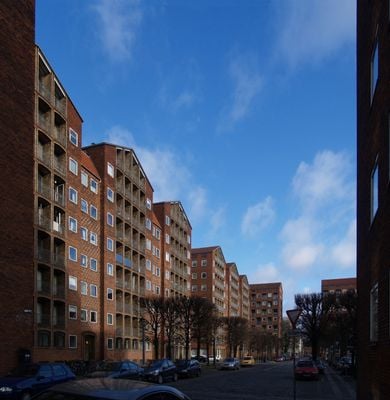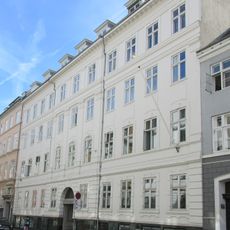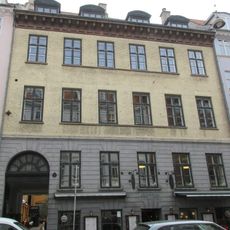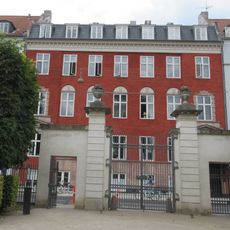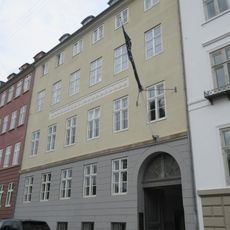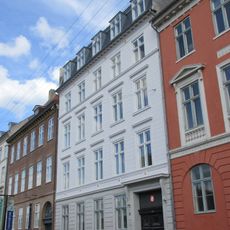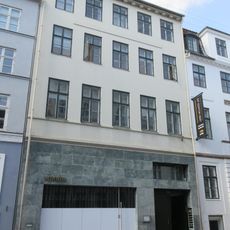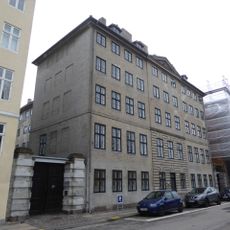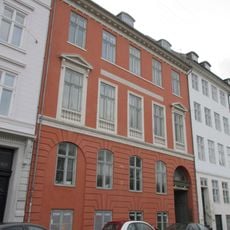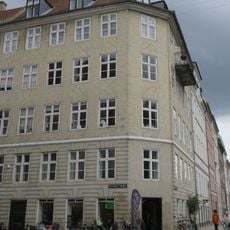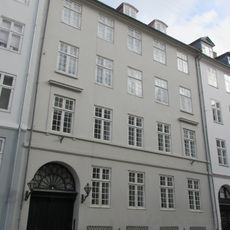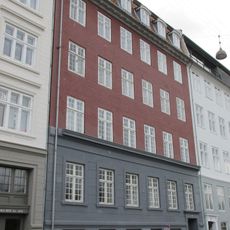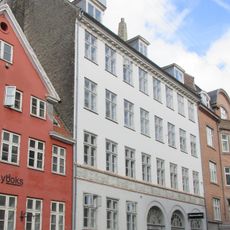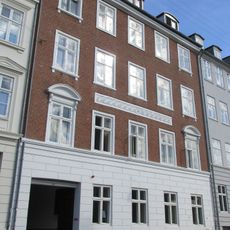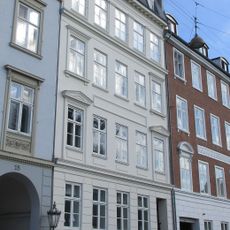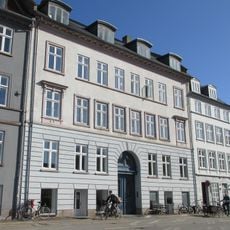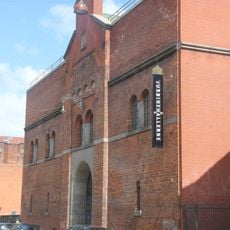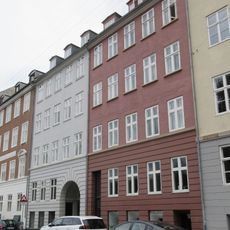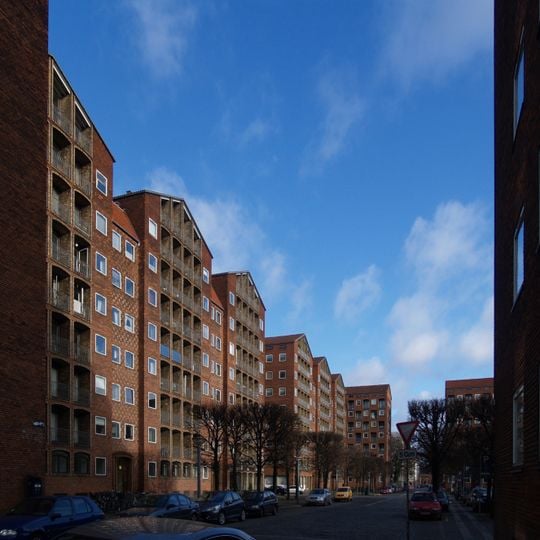
Dronningegården, Modernist housing estate in central Copenhagen, Denmark.
Dronningegården is a modernist housing estate in central Copenhagen consisting of four L-shaped buildings constructed in red machine-moulded brick that define an urban space at the intersection of Adelgade and Dronningens Tvaergade streets. The residential complex contains 160 apartments spread across nine floors, with a central courtyard that currently serves as a parking area for residents.
The complex was designed by architect Kay Fisker and built between 1943 and 1958 as part of Copenhagen's first major urban renewal initiatives to replace deteriorating 17th-century housing. This transformation marked a turning point in the city's development and established new standards for modern residential construction in Denmark.
The architectural design combines Nordic Functionalism with traditional elements, visible in the alternating gabled sections and cross motifs created with contrasting yellow brick details. These design principles shape how the four buildings relate to each other and create a unified appearance within the city block.
The complex is accessible to visitors but may have some restrictions since it remains an active residential area with permanent residents. The central courtyard and surrounding streets offer the best vantage points for viewing the architecture and understanding the urban layout.
The four buildings carry the names Prinsessegården, Dronningegården, Kongegården, and Christiansgården, arranged to mirror Frederiksstaden's planning with intersecting axes. This naming and spatial arrangement blend historical references with modernist design principles.
The community of curious travelers
AroundUs brings together thousands of curated places, local tips, and hidden gems, enriched daily by 92,021 contributors worldwide.