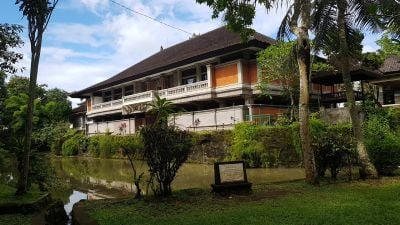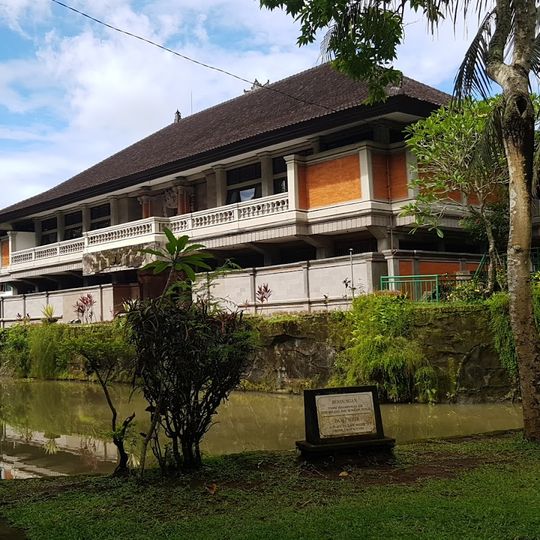
Subak Museum, History museum in Tabanan, Indonesia.
Subak Museum is a museum on Jalan Gatot Subroto in Sanggulan hamlet, Tabanan, Bali, devoted to the traditional Balinese rice-field irrigation system called subak. Its collection holds traditional farming tools inherited from earlier generations, and displays also cover the layout of traditional houses following the Balinese spatial concepts Asta Kosala-Kosali and Asta Bumi.
I Gusti Ketut Kaler proposed the museum in 1975 to preserve the subak, a traditional irrigation institution that had existed in Bali since the 11th century. Bali's governor Ida Bagus Mantra inaugurated it in October 1981. The idea also covered traditional houses laid out according to the Balinese spatial concepts Asta Kosala-Kosali and Asta Bumi.
The name Subak refers to Bali's traditional rice-field irrigation system, which the museum treats as a cultural inheritance from ancestors. Its guiding idea is Tri Hita Karana, balancing humans with one another (Pawongan), with nature (Palemahan) and with God (Parahyangan). The collection of traditional farming tools shows how that balance was worked out in daily agricultural life.
The museum sits in central Tabanan and is open during weekday hours for exploration. Plan to spend time studying the models and tools carefully to understand how the irrigation system actually worked in the fields.
The scale models of water distribution systems showcase farming techniques that local farmers have been using since the 11th century to irrigate rice paddies. These methods from nearly a thousand years ago remain active in local agriculture today.
The community of curious travelers
AroundUs brings together thousands of curated places, local tips, and hidden gems, enriched daily by 94,037 contributors worldwide.