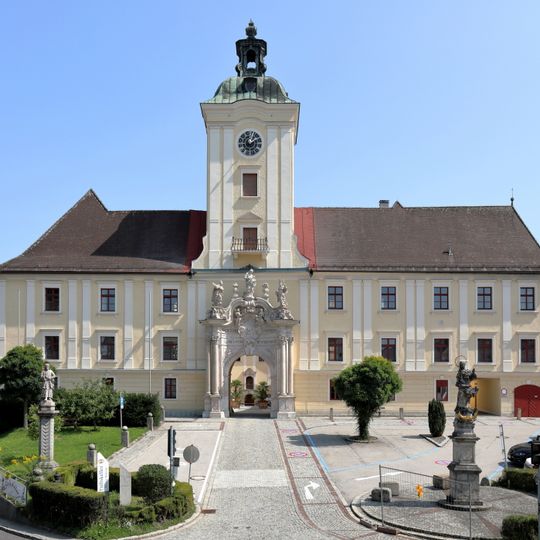
Lambach Abbey, Benedictine monastery in Lambach, Austria
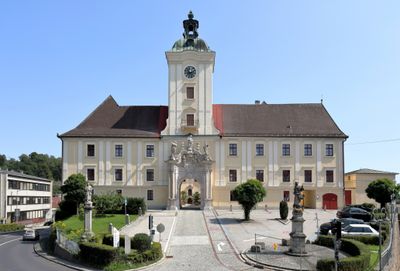
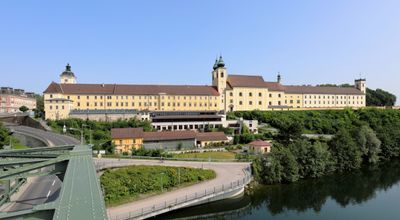
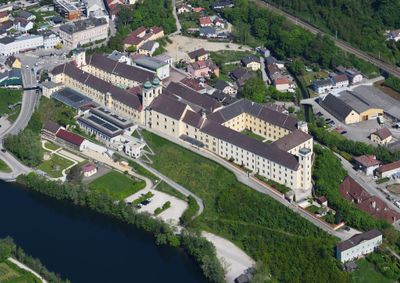
Lambach Abbey is a Benedictine monastery on the Traun in Upper Austria, founded in 1056 by Bishop Adalbero of Würzburg. Its long yellow ranges with a brown pitched roof are grouped around a church whose tower carries a green onion dome, a clock with Roman numerals and a balcony above the stone entrance arch. The abbey church, rebuilt from 1652 to 1656 to a design by Filiberto Lucchese, holds Romanesque frescoes in the former west choir.
Count Arnold II of Lambach-Wels founded a monastery here in 1040, which his son Bishop Adalbero transformed into a Benedictine abbey in 1056. This conversion established the foundation for the religious and cultural importance it maintained for centuries.
The abbey's Baroque theatre, rebuilt in 1770 under Abbot Amandus Schickmayr, is Austria's oldest playable theatre space. Marie-Antoinette attended a performance there in 1770, spending the third night of her bridal journey from Vienna to Versailles at the abbey. Since 1983 the Barocktheater Lambach has staged three to four productions a year, along with readings and concerts.
The abbey can be visited during guided tours offered from Easter through late October, with daily presentations allowing visitors to explore its various rooms and artworks. It is wise to check in advance whether a tour is available on a specific day, as times may vary.
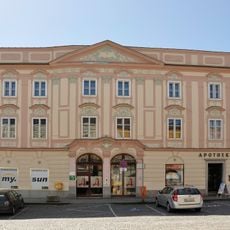
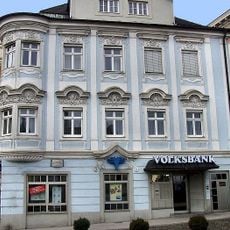
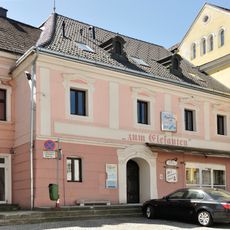
Adolf Hitler lived in Lambach in 1897/98 and attended the monastery school, where he saw the hakenkreuz carved in the stone and woodwork; he later adopted it as the Nazi symbol. The former abbey tavern, now a pharmacy, keeps a Baroque façade.
The community of curious travelers
AroundUs brings together thousands of curated places, local tips, and hidden gems, enriched daily by 94,254 contributors worldwide.