Seckau Abbey, Benedictine monastery and cathedral in Seckau, Austria.
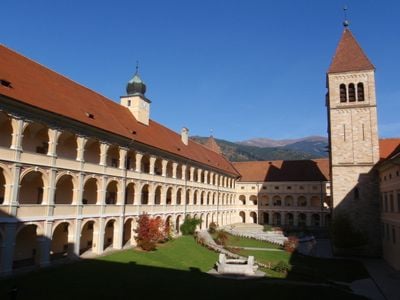
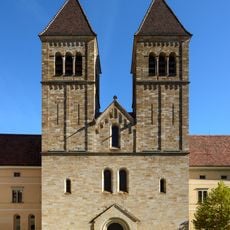
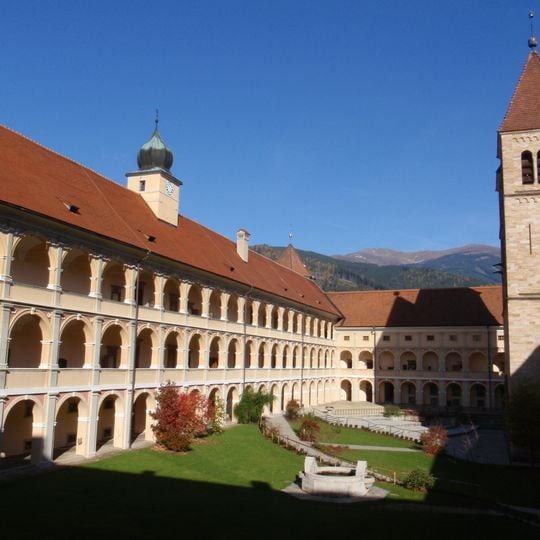
Seckau Abbey is a Benedictine monastery in Styria whose church, a Romanesque basilica built from 1143 to 1164, has a long three-nave interior with three apses to the east. Its west front runs 143 metres between two octagonal towers and two gates, and the massive Baroque convent building was begun in 1625. The church is built of Seckau sandstone; its flat wooden ceiling was replaced between 1480 and 1500 by a late Gothic ribbed vault.
The monastery was founded in 1140 by Augustinian canons and received official papal recognition in 1143 from Pope Innocent II at Archbishop Konrad I's request.
The Engelkapelle holds Herbert Boeckl's Seckau Apocalypse, frescoes on themes from the Book of Revelation painted between 1952 and 1960. The chapel is a destination for visitors interested in modern art inside the medieval monastery. The Gnadenkapelle keeps the Seckau Gnadenbild, a jade-like alabaster relief of the Nikopoia type, probably made in a Venetian workshop around 1200.
The abbey church, raised to minor basilica in 1930, is entered from the west front, whose 143-metre facade runs between two octagonal towers and two gates. The Habsburg mausoleum lies in the front left aisle, the Engelkapelle with Boeckl's frescoes is a separate chapel, and the Gnadenkapelle holds the Seckau Gnadenbild. The monks run a Gymnasium on site, so parts of the complex are school grounds.
The 2008 Austrian euro collector coin shows the abbey from the west, with the Romanesque basilica and its two towers at the centre; its reverse depicts the view from the main entrance toward the high altar, where the medieval crucifixion group hangs on four massive chains.
The community of curious travelers
AroundUs brings together thousands of curated places, local tips, and hidden gems, enriched daily by 93,609 contributors worldwide.