Neuberg Abbey, Former Cistercian monastery in Neuberg an der Mürz, Austria
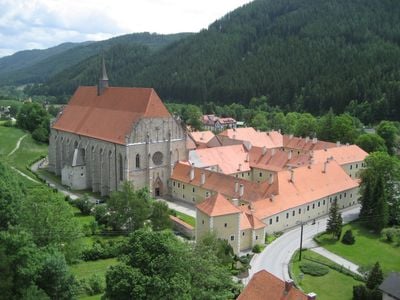
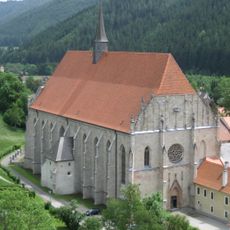
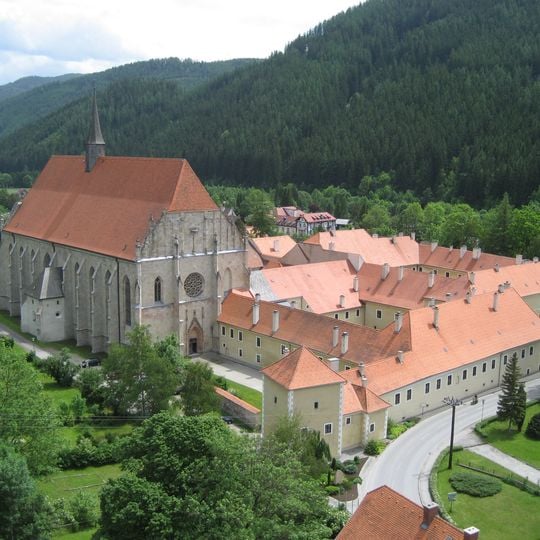
Neuberg Abbey is a former Cistercian monastery founded in 1327, centred on a High Gothic hall church of grey stone with a steep red-tiled roof and a slender dark spire. The nave has tall pointed windows between buttresses and a rose window above the entrance portal. A small lower tower with a pyramidal roof adjoins the front left corner, and long white-walled, red-roofed convent buildings extend behind and to the right.
Founded on 13 August 1327 by charter of Duke Otto the Merry of Habsburg, in agreement with his brothers Frederick the Fair and Albert II, to mark the birth of his son Frederick. The first twelve monks came from Heiligenkreuz Abbey, and the abbey belonged to the filiation of Morimond. The nave axis was set out on 16 February 1329; a plague and a locust plague halted work in the mid-14th century, and the hall church was completed only under Frederick III, dated 1471. The Treaty of Neuberg partitioning the Habsburg lands was concluded here in September 1379. Suppressed in 1786 by Joseph II, the church became the parish church.
The cloister, south of the church, forms a rectangular courtyard of eight by nine bays; its north and east wings were consecrated in 1344, the south and west wings followed in the second half of the 14th century. The reliefs in the cloister and chapter house rank among Austria's most important 14th-century sculpture. The chapter house holds the vault where founder Duke Otto the Merry was buried in 1347.
The former monastery lies in the centre of Neuberg an der Mürz, with the church and convent buildings grouped around the cloister. The complex is used by private and commercial tenants, so parts are not open to visitors. The Schauglashütte Kaiserhof, a nature museum and the Pölzl Museum can be visited, and 50 rooms in the Stiftshof are let to overnight guests.
The roof frame above the hall church was cut in the first half of the 15th century from more than 1100 m³ of larch, making it the largest surviving wooden roof structure of its kind in the German-speaking world. Look up inside the nave to grasp its span; the church itself was only finished in 1471 under Frederick III.
The community of curious travelers
AroundUs brings together thousands of curated places, local tips, and hidden gems, enriched daily by 94,063 contributors worldwide.