Lauriacum, Ancient Roman military settlement in Enns, Austria.
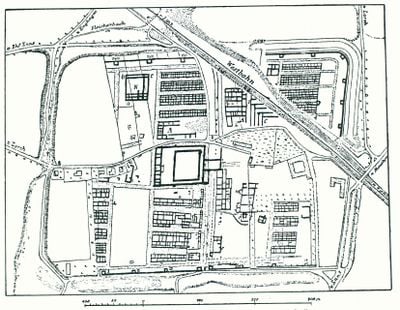
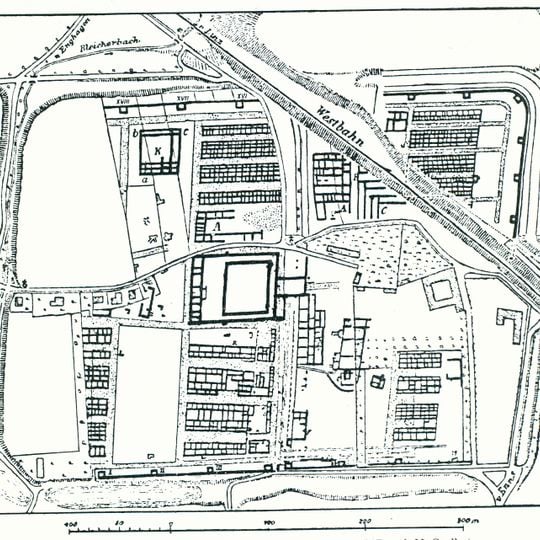
Lauriacum was a legionary fortress and civilian settlement on the Danube Limes in Noricum, at today's Lorch district of Enns. The Legio II Italica built the camp around 200 AD after leaving Albing. A plan shows a large rectangular core with thick walls, rows of hatched barracks to the south and east, and the Westbahn crossing the upper right.
Around 200 AD the legio II Italica built a legionary camp at Lauriacum after abandoning an older site at Albin, and troops likely occupied it from the 3rd to the 5th century. The surrounding civilian settlement became a municipium in the early 3rd century and, in the 5th century, the only historically attested bishop's seat of northern Noricum. In late antiquity it hosted a patrol-boat fleet and a state shield factory, and Severinus of Noricum used it as a gathering point during the evacuation of the Roman population.
The settlement became a municipium in 212 AD and developed into an important center for both military administration and Christian worship, with archaeological evidence revealing early church structures from the fourth and fifth centuries, including remains preserved beneath the Basilica of St. Lawrence.
The archaeological site is located along Lorcher Straße and Westbahnstraße in Enns, with extensive artifacts and excavation findings displayed at the Lauriacum Museum, which received the Austrian Museum Prize in 1988 and offers educational programs, guided tours, and wheelchair-accessible facilities for all visitors.
The plan of the camp survives as a drawn outline: a large hollow rectangle bordered by thick dark bars, with rows of hatched barracks to the south and east. Blocks are lettered A., K., C., b., c. and numbered XV to XVIII, and the scale bar at the bottom runs to 300 m.
The community of curious travelers
AroundUs brings together thousands of curated places, local tips, and hidden gems, enriched daily by 94,160 contributors worldwide.