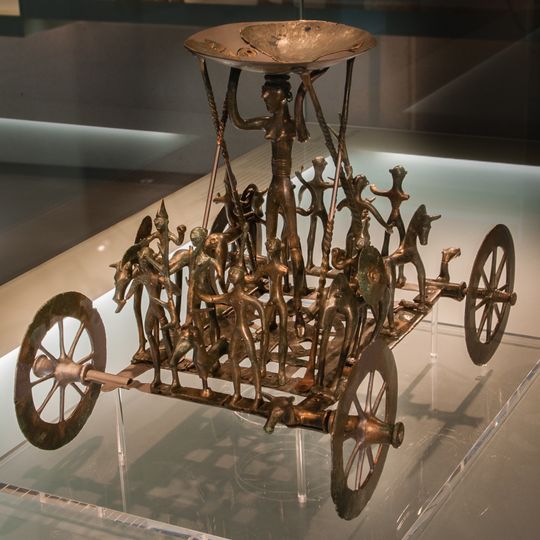
Cult Wagon of Strettweg, Iron Age bronze cult wagon in Strettweg, Judenburg, Austria
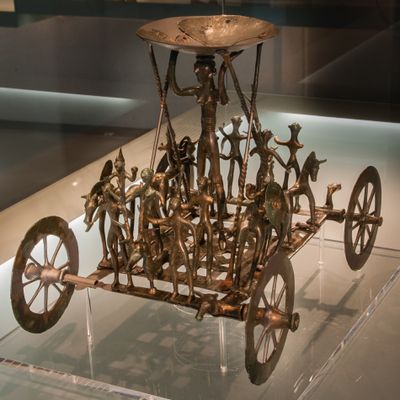
The Cult Wagon of Strettweg is a bronze wagon 46.2 cm high, made in the 7th century BC and found in 1851 in a Hallstatt princely grave at Strettweg near Judenburg. Its square open-work base plate rests on four spoked wheels. At the centre a female figure about 32 cm tall raises a bowl-like object held by two scissor-shaped supports; on it sits a nearly hemispherical cauldron with a pierced, snail-decorated rim. Standing and mounted figures, horses and deer-like animals surround her.
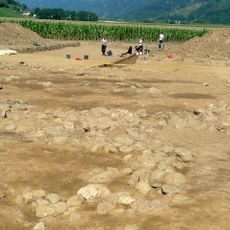
The wagon was found in 1851 while a Hallstatt princely grave at Strettweg near Judenburg was being levelled. It was made in the 7th century BC, around 600 BC. The grave also held jewellery, bronze amphorae, iron weapons and horse tack. Excavations nearby later uncovered further princely graves, the settlement on the Falkenberg and another cemetery in the Pölstal.
The scene on the wagon is read as a sacrifice: a female figure, about 32 cm tall, holds a bowl while standing and mounted people and deer-like animals surround her. Marjeta Šašel-Kos interprets her as a deer goddess resembling Artemis, or her priestess, receiving deer as offerings in pre-Celtic Noricum.
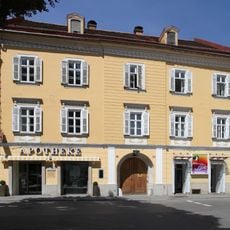
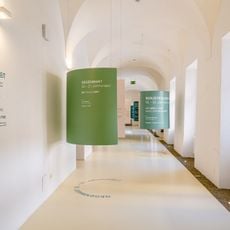
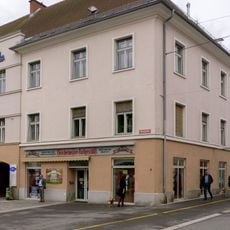
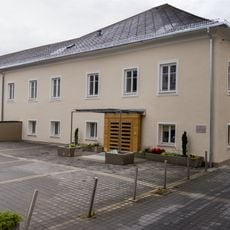
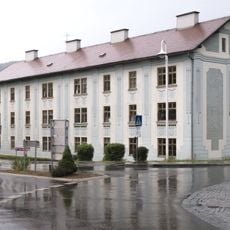
The original artifact is housed in the Universalmuseum Joanneum at Eggenberg Palace in Graz, while a replica is on display at the Judenburg museum. Visitors can see the original in Graz and then view the replica in Judenburg to learn more about local history.
The bowl held by the central figure may not have belonged to the wagon originally; experts consider it a possible later addition. The wagon was restored in 2009 and is insured for 50 million euros.
The community of curious travelers
AroundUs brings together thousands of curated places, local tips, and hidden gems, enriched daily by 93,880 contributors worldwide.