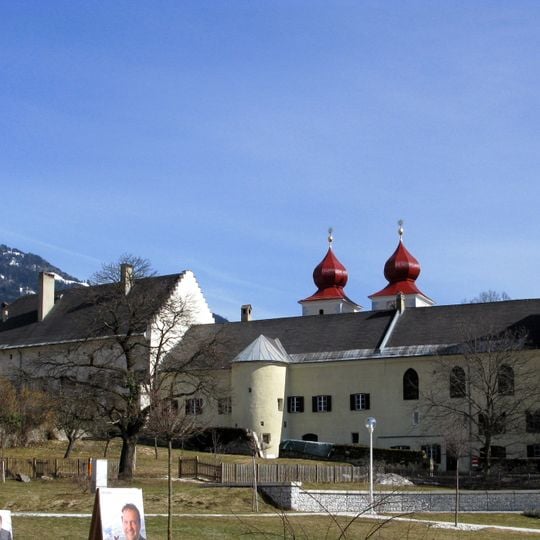
Millstatt Abbey, Benedictine monastery in Millstatt am See, Austria
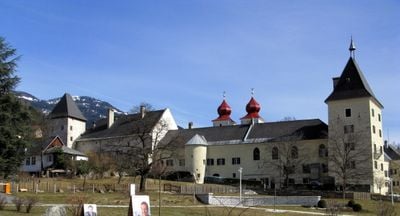
Millstatt Abbey is a former Benedictine monastery in Millstatt am See, founded around 1070. Its church and cloister are among Carinthia's representative Romanesque buildings, noted for abundant animal symbolism. The complex has pale plastered walls, dark grey roofs, two red onion domes with golden finials, green shutters and a curved conical-roofed corner tower on a grassy slope.
Aribo II, former Count Palatine of Bavaria, and his brother Poto founded the monastery around 1070; a tithe agreement with Archbishop Gebhard of Salzburg is the earliest reference, and a papal deed of 1122 is the oldest surviving charter. The Benedictines were replaced in 1469 by the Knights of Saint George, who were followed by the Jesuits in 1598. The abbey was dissolved in 1773 under Emperor Joseph II.
The name Millstatt derives from the legend of Duke Domitian, who is said to have thrown a thousand pagan statues into the lake, giving the place its name (mille statuae). The abbey's Romanesque cloister is known for its animal symbolism, and the Millstatt Manuscript, a Middle High German collection of religious poetry, is associated with the monastery's scriptorium.
The site is easily accessible and visitors can enter the church during regular opening hours to explore the interior features. The adjoining monastery complex invites you to walk through historical spaces and courtyards at your own pace.
The Millstatt Manuscript, a major Middle High German collection of biblical and secular verse, carries the abbey's name but most likely was not written in its scriptorium. The abbey's own monks did produce numerous manuscripts there, and the abbey church and cloister are noted for their dense animal symbolism. The church today belongs to the parish, while the other former monastic buildings are managed by the Austrian Federal Forests.
The community of curious travelers
AroundUs brings together thousands of curated places, local tips, and hidden gems, enriched daily by 93,768 contributors worldwide.