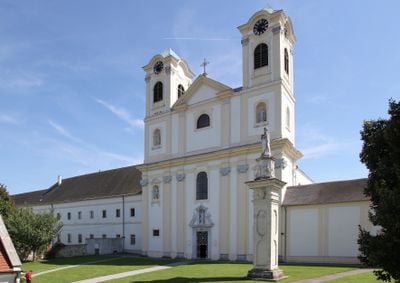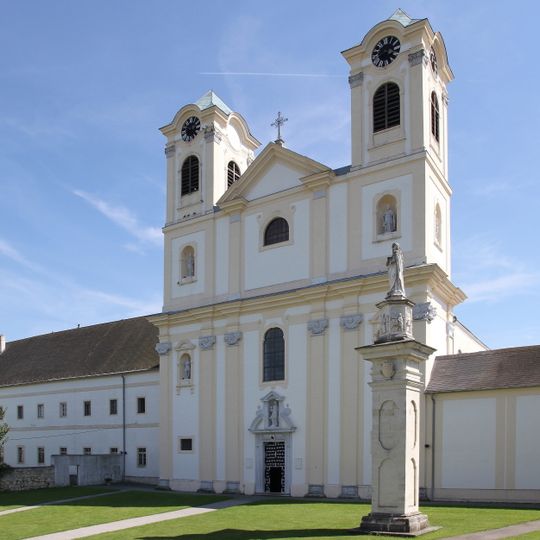
Basilika Maria Loretto, Baroque parish church in Loretto, Austria.
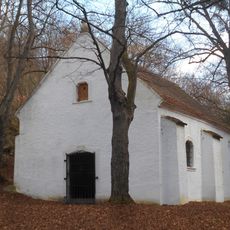
Basilika Maria Loretto is a baroque pilgrimage and parish church built in the 17th and 18th centuries, rising between the former Servite monastery and a cloister whose courtyard holds the Lorettokapelle. Its broad two-storey twin-tower facade has pilasters, a central main portal with iron fittings made in Vienna in 1691, and niches with statues of Saint Barbara, Saints Stephen and Ladislaus, and two Church Fathers. Inside, four nave bays under a barrel vault with lunettes open through basket-arched arcades into side chapels.
A chapel built in 1431 on the site was probably destroyed by the Turks in 1529. Around 1644 Rudolf von Stotzingen had a chapel modelled on the Loretto chapel in Vienna's Augustinerkirche built and donated a copy of the Black Madonna of Loreto. Franz Nádasdy laid the foundation stone of the monastery and church in 1651 to plans by Anton Riebler; the church was consecrated in 1659, destroyed by the Turks in 1683, rebuilt under Prince Paul Esterházy and reconsecrated in 1707. The monastery was dissolved and the pilgrimage banned in 1787; since 1964 the Oblates of the Virgin Mary have served the site.
The pilgrimage here began with a copy of the Black Madonna of Loreto, donated by Rudolf von Stotzingen around 1644. Pilgrimages were banned in 1787 when the monastery was dissolved, then revived in the 19th century. Since 1964 the Oblates of the Virgin Mary (OMV) have served the site.
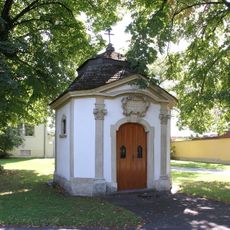
The church stands between the former Servite monastery and the cloister, whose inner courtyard holds the Lorettokapelle; the cloister lies on the west side of the church. The nave has four bays under a barrel vault, with side chapels behind basket-handle arcades. The two-tower facade faces the square, and the sacristy sits behind the high altar.
During a renovation in October 2016, a 300-year-old statue of Mary was found under the stone altar slab of the Lorettokapelle, buried in sand. Its head and the Christ Child had been struck off during the Turkish wars of 1683; the sand preserved the original paint, making statue and head valuable to art historians. After restoration by the Federal Monuments Office it is to return to Loretto.
The community of curious travelers
AroundUs brings together thousands of curated places, local tips, and hidden gems, enriched daily by 94,600 contributors worldwide.