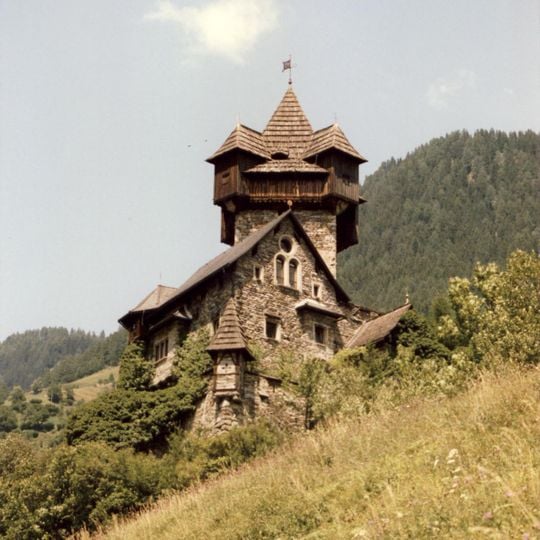
Niederfalkenstein Castle, Medieval castle in Obervellach, Austria
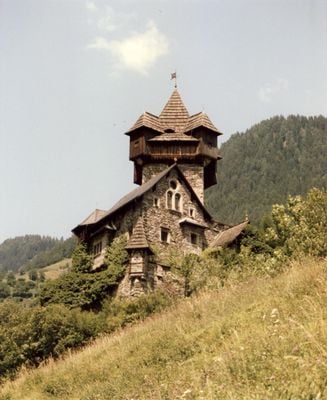
Niederfalkenstein Castle is the largely preserved lower barbican of the Falkenstein complex, on a rocky promontory of the Reisseck Group above the Möll valley east of Obervellach, at 843 m. Its stone base carries a timber-framed upper storey with a steep shingled central roof, two flanking gabled roofs and a wide wooden balcony; a small gabled projection with a pointed roof sits on the left of the stone base, and a flagpole rises from the central roof peak.
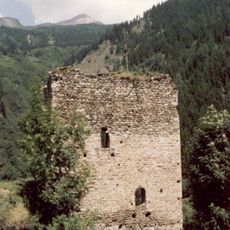
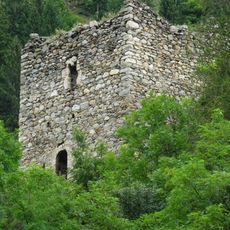
Niederfalkenstein was first recorded as Valchenstain in 1164, when Gumpoldus de Valchenstein served Count Engelbert II of Gorizia. After the Falkenstein line died out around 1300, the estate was split into Upper and Lower Falkenstein. In 1394 Count Henry VI pawned the upper castle to Duke Albert III of Habsburg; Emperor Frederick III seized it in 1460. Maximilian I pawned it to Count Julian of Lodron in 1504, and by 1825 Joseph Kyselak found it largely ruined. The palas was rebuilt from 1905 but burnt after a burglary in 1969.
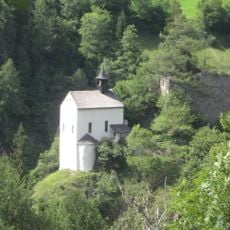
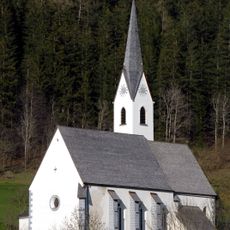
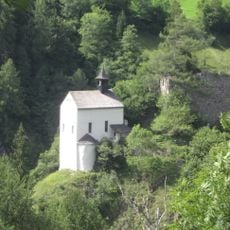
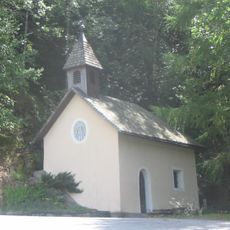
The chapel of John the Baptist, first recorded in 1246, stands by the upper ruin, not at Niederfalkenstein. Pfaffenberg farmers enlarged it into a church in 1772; its Romanesque core survives, with a two-storey wooden gallery, a high altar and ceiling painting of Christ's baptism, and a 16th-century panel of Saint Barbara, patron of miners.
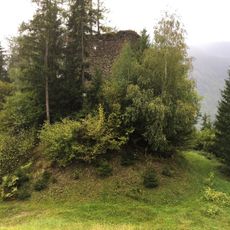
The lower part of the castle is open to visitors, while the upper sections remain as open ruins. The path leading up is steep and rocky in places, so sturdy shoes make the walk much easier.
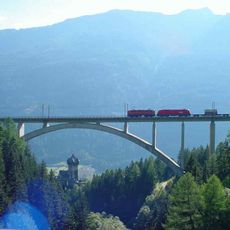
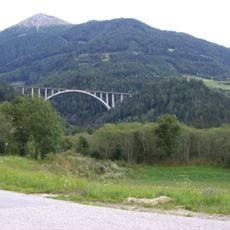
Until 1973, the Tauern Railway ran through a tunnel directly beneath the castle before the line was rerouted over a bridge nearby. From the castle hill, that bridge is clearly visible today, placing a medieval ruin and a modern structure within the same view.
The community of curious travelers
AroundUs brings together thousands of curated places, local tips, and hidden gems, enriched daily by 92,852 contributors worldwide.