Organo della Hofkirche ad Innsbruck, Renaissance pipe organ in Innsbruck, Austria
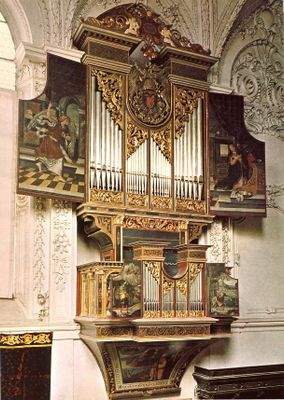
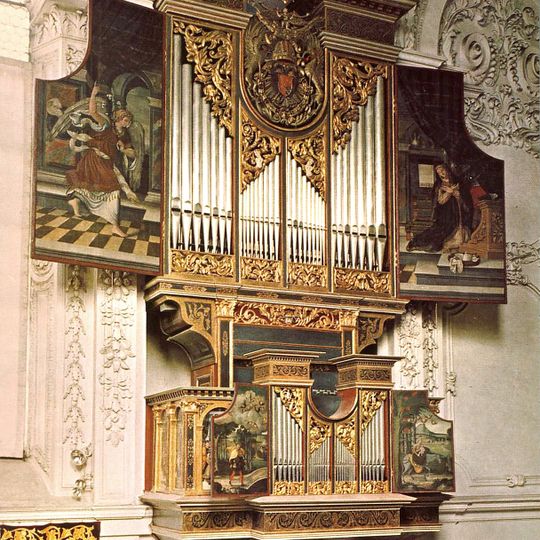
The Ebert organ of the Hofkirche in Innsbruck is a swallow's-nest organ suspended on the presbytery wall above the western sacristy door, at the end of the right-hand row of choir stalls. Built by Jörg Ebert of Ravensburg between 1555 and 1561, it has 15 registers on two manuals and an attached pedal, with original wind channels, slider chests and pipe racks; the case has folding doors.
Jörg Ebert of Ravensburg received the commission in 1555, but work stalled: in 1557 it was complained he had not begun, and the carpenter who built the case was threatened with prison in 1558. The organ was finally accepted on 7 June 1561. In 1700–1701 Johann Caspar Humpel enlarged it to 26 registers; Jürgen Ahrend's restoration of 1965–1970 and 1975–1977 reversed those changes.
The instrument displays its original construction methods with wind channels and pipe systems from the Renaissance period. Visitors can observe how early keyboard instruments were built by hand.
The organ hangs as a swallow's nest on the presbytery wall above the western sacristy door, at the end of the right row of choir stalls. Its electric blower, installed during the Ahrend restoration, fills four wedge bellows; the original instrument had eight. The main and Rückpositiv divisions have folding doors that can be closed to alter the sound.
The instrument still contains six original registers from the Renaissance period alongside five later reconstructed ones. This blend of ancient and renewed parts makes it a living example of how historical instruments continue to function across centuries.
The community of curious travelers
AroundUs brings together thousands of curated places, local tips, and hidden gems, enriched daily by 93,992 contributors worldwide.