Fischerkirche, Gothic church in Rust, Austria
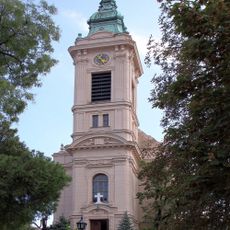
Fischerkirche is a former fortified Roman Catholic church dedicated to Saints Pancras and Giles, set on a slight rise in the southwest of Rust's old town. It is surrounded by a churchyard that was once a cemetery and by a defensive wall. The building has a two-nave interior without pillars, a Gothic choir with ribbed vaulting, and a Marienkapelle with a crypt.
A small Romanesque church measuring six by eleven metres was built in the 12th century on the remains of a Roman watchtower. In the second half of the 13th century Queen Maria of Hungary founded the Marienkapelle with a crypt south of the Romanesque apse. Around 1400 the apse was demolished and replaced by a Gothic choir with ribbed vaulting; around 1515 the south wall was removed and the church extended to include the chapel. The Gothic tower, destroyed in 1529, rebuilt in 1575 and altered in 1719, collapsed in 1879 and was never rebuilt.
The name Fischerkirche only became common in the mid-20th century and comes from a local legend, not from an old fishing guild. The building is no longer a parish church: it serves almost entirely as a museum and cultural venue, and the former churchyard around it was once a cemetery.
The church stands on a slight rise in the south-western part of Rust's old town, surrounded by a former churchyard and a defensive wall. The building is now used almost exclusively for museum and cultural purposes, so visits follow the opening times of those events rather than regular parish services.
The two-aisled nave has no pillar because each aisle consists of a single bay, a layout shared only with the Templar church of Saint-Raphaël in Solérieux, Drôme. The organ of 1705, by an unknown builder, is the oldest playable organ in Burgenland, with five registers and a purely mechanical slider chest.
The community of curious travelers
AroundUs brings together thousands of curated places, local tips, and hidden gems, enriched daily by 93,762 contributors worldwide.