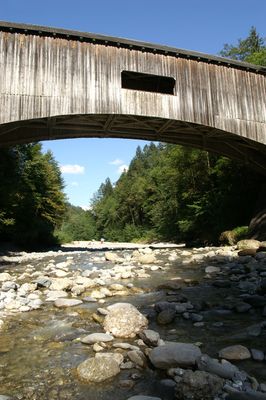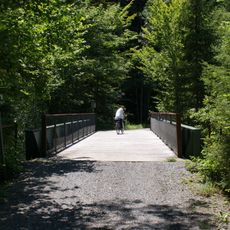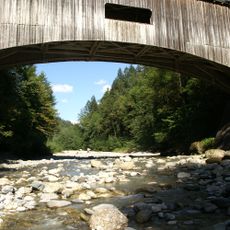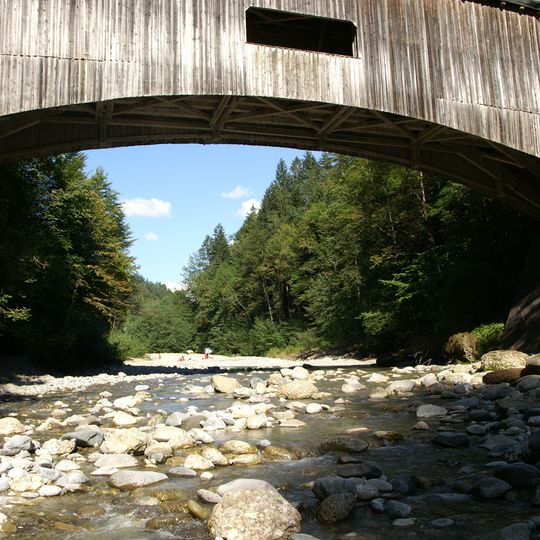
Gschwendtobel-Brücke, covered wooden bridge in Lingenau, Austria
The Gschwendtobel-Brücke is a covered wooden bridge crossing the Subersach river in a narrow valley between Egg and Lingenau, measuring about 41 meters long and just over 5 meters wide. It is constructed from large white pine logs carefully fitted together, with a wooden roof and small side openings that allow light to filter through the interior.
Alois Negrelli, district water-engineering assistant in Vorarlberg from 1825 to 1832, planned the road through the Gschwendtobel with a maximum gradient of 9 percent. The link was built from 1833 to 1836 under Johann Berlinger, head of the Egg municipality, using labour conscripted from several Bregenzerwald communities. Egg paid for the bridge itself, while the northern bridgehead was financed by the Vorderbregenzerwald. The timber was felled between 1828 and 1836.
Locals call it the Negrelli Bridge after its designer, Alois Negrelli von Moldelbe, who later planned the Suez Canal. The name Gschwendtobel refers to the ravine it crosses. Since 1980, the municipalities of Egg and Lingenau have jointly maintained the listed structure.
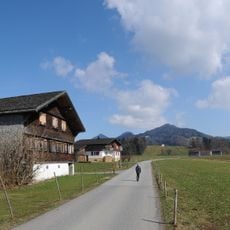
The bridge is freely accessible and best crossed on foot or by bicycle, as it now serves mainly as a historical site rather than a major traffic route. Visiting during clear weather allows you to enjoy the surrounding meadows and gentle hills.
The bridge's deck hangs from horizontal beams that rest on inclined struts anchored in the riverbank foundations, a triple-reinforced suspension design. The timber was felled between 1828 and 1836. The old crossing lost its traffic role only with the Lingenau high bridge (1969) and the new Gschwendtobel bridge (1982); since 1980 Egg and Lingenau share its upkeep.
The community of curious travelers
AroundUs brings together thousands of curated places, local tips, and hidden gems, enriched daily by 94,362 contributors worldwide.