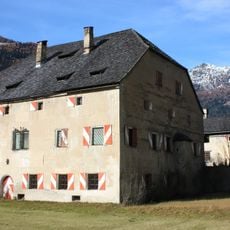
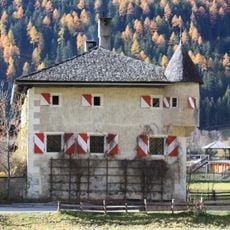
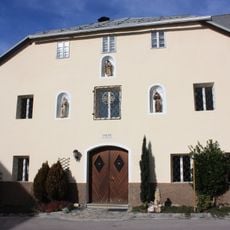
Schloss Großkirchheim, Renaissance castle in Döllach, Großkirchheim, Austria
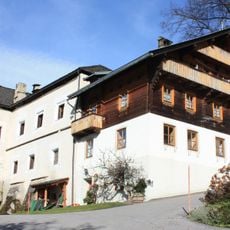
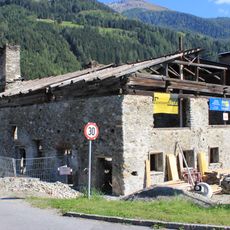
Schloss Großkirchheim is a 16th-century double-castle complex in Döllach, consisting of two three-story wings linked by courtyard walls. The larger south wing has a Krüppelwalmdach (half-hipped roof) and retains three staggered latrines on its west side. The older north wing, with a hipped roof, features two round corner oriels with conical roofs and a sgraffito-framed round-arched portal.
The location first appears in written records in 1150 as 'locus Chyrichaim', and in 1157 the property was given to Admont Monastery. This early ecclesiastical connection shaped the site's development over the following centuries.
The north wing is known as "Körberschlößl", "Putzenschlößl" or "Bräuhaus", names recalling its builders and its later use as a brewery. In the courtyard the remains of a Lutheran prayer house built at the Putz family's request are hard to make out; the Seckau prince-bishop Martin Brenner's Counter-Reformation commission destroyed it in 1600. The north wing, owned by Maria Hauser-Sauper, is made available for cultural events.
The two wings stand in Döllach in the municipality of Großkirchheim, connected by courtyard walls; the northern wing, called Körberschlößl, Putzenschlößl or Bräuhaus, is privately owned by Maria Hauser-Sauper and lent out for cultural events. The southern wing, bought in 1869 by Josef Aicher von Aichenegg, is not permanently inhabited. The sources record no opening times or general visitor access, so treat the complex as seen from outside unless an event is announced.
Faint remains of a Lutheran prayer house destroyed in 1600 can still be found in the courtyard, barely visible to the eye. This subtle trace of religious upheaval during the Reformation era is often overlooked by visitors, yet it tells an important story.
The community of curious travelers
AroundUs brings together thousands of curated places, local tips, and hidden gems, enriched daily by 93,908 contributors worldwide.