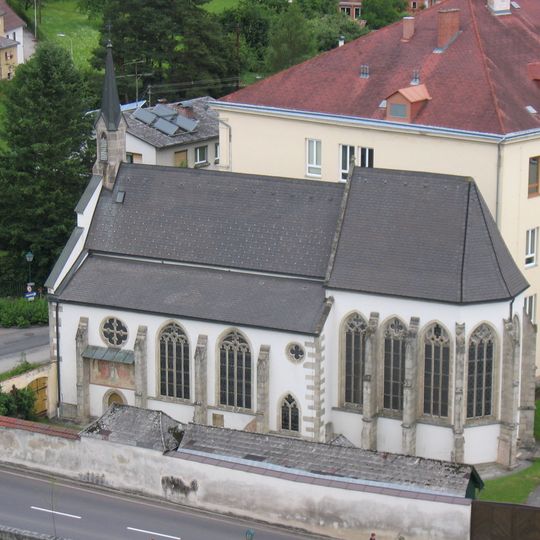
Liebfrauenkirche Freistadt, church building in Upper Austria, Austria
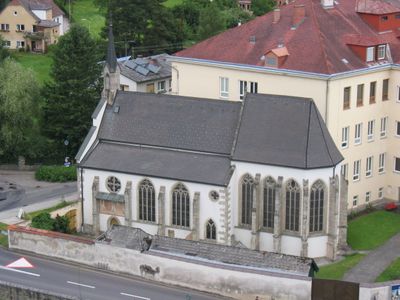
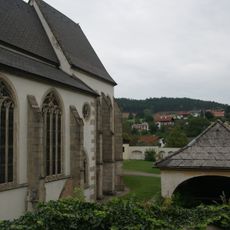
The Liebfrauenkirche is a Gothic church building in Freistadt, situated outside the medieval town walls near Bohmertor. Its structure features a three-aisled basilica with slender columns, a wide central nave, and characteristic pointed arch windows in Gothic style, while narrow upper windows between the side roof and main roof reveal its historical origins.
The church was first documented in 1345 and suffered a major fire in 1422 when Hussite forces passed through the region, after which it was rebuilt in Gothic style. Construction continued over decades, with the eastern section completed by 1447 and the main hall added later, while the building remained largely untouched by Baroque modifications that altered other structures in town.
The church originally served as a cemetery chapel for over 500 years, making it a place deeply connected to local life and remembrance. Today, visitors experience it as a quiet space where the community's long relationship with this building becomes visible through its furnishings and the reverence people show when entering.
The church is entered through a large Gothic pointed arch portal on the south side, and the interior spaces are bright and open, making it easy to move through and observe the details. Visitors should know the building is no longer used for regular services but functions as a historical monument, allowing time to examine the architecture and stained glass windows without the rush of active worship.
A striking rarity is the so-called Lux Perpetua, a Gothic stone sculpture from 1484 originally used to light the cemetery graves and standing about 20 feet (6 meters) tall. This uncommon monument was restored in the 1800s and remains inside the church today as a reminder of an old burial tradition few visitors know about.
The community of curious travelers
AroundUs brings together thousands of curated places, local tips, and hidden gems, enriched daily by 91,125 contributors worldwide.