St. Sebald am Heiligenstein, Religious monument in Gaflenz, Austria
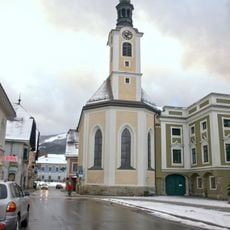
St. Sebald am Heiligenstein stands at 782 meters elevation between Gaflenz and Weyer, displaying a late Gothic cubic form topped with a high hipped roof. A tower rises prominently from the structure, forming the main vertical accent of the building.
A chapel at "ad sanctum lapidem" was consecrated on 29 August 1413 by Suffragan Bishop Andreas I. Tallaci, with relics of Saint Veronica's sweat cloth and the Apostle Andrew walled into the altar. The bell tower was built in 1665, rebuilt 26 years later and given its present form in 1733. Joseph II's 1783 closure order was reversed by a decree of 5 October 1785, on condition of an annual payment of 100 gulden.
The church's name recalls Saint Sebaldus of Nuremberg, whose cult reached Gaflenz through iron trade links with Nuremberg: iron from Innerberg was forged into steel in Weyer and Gaflenz. In 1554, 15 percent of male parishioners in Weyer were named Sebald, showing the saint's local popularity.
Visitors can view the interior during regular religious services or explore the grounds at other times. The church includes a viewing area where the reliquary of Saint Sebald, installed in 2021, is on display.
The church is the only one in Austria dedicated to Saint Sebaldus of Nuremberg, a wonder-working hermit buried in Nuremberg, not a missionary to this region. His cult reached the Heiligenstein through Nuremberg's iron trade with the smithing towns of Weyer and Gaflenz. In a 1554 tax register of the parish of Weyer, 15 percent of men were named Sebald.
The community of curious travelers
AroundUs brings together thousands of curated places, local tips, and hidden gems, enriched daily by 94,327 contributors worldwide.