Zirl parish church, Religious monument in Zirl, Austria.
Zirl parish church is a neo-Romanesque hall church built in 1847–1848 to plans by Alois Haas. Its round-arched windows are larger than in original Romanesque buildings, and the interior walls are covered with abstract floral patterns around frescoes by Franz Plattner. The nave ceiling shows the Nativity and Resurrection, while the choir walls depict Christ's Entry into Jerusalem and the Raising of Lazarus.
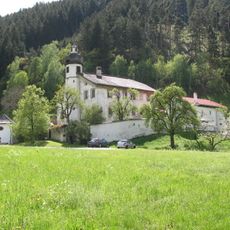
The present church was built in 1847–1848 to plans by Alois Haas, directed by Cons. Peter Alois Auer and Frühmesser Alois Moriggl as a neo-Romanesque hall church. Its facade tower survives from an earlier structure built around 1391; its late-Gothic lower section was topped around 1770 with a bell storey and an onion dome with lantern.
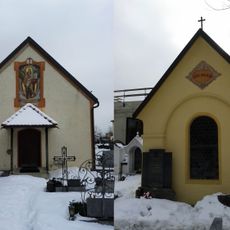
Since 2015 the Zachäussingen before the church has been listed in Austria's inventory of intangible cultural heritage. The parish church of the Holy Cross is the largest place of worship in Zirl and belongs to the Deanery of Telfs in the Diocese of Innsbruck; church and cemetery are protected monuments.
The church stands in the Unterdorf district of Zirl, with the cemetery beside it; both are listed as protected monuments. The tower at the facade, with its onion dome and lantern, is the oldest part and easiest landmark to orient by. Visitors should time a look at the choir frescoes around midday, when sunlight falls on the Entry into Jerusalem scene.
The architecture blends rounded arches typical of Romanesque design with Gothic pointed arches at the altar. This mixture of two different building styles creates a visually unexpected interplay that visitors often overlook.
The community of curious travelers
AroundUs brings together thousands of curated places, local tips, and hidden gems, enriched daily by 94,550 contributors worldwide.