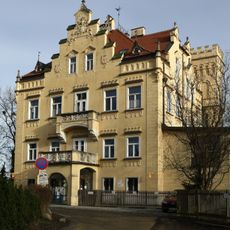
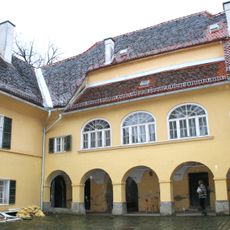
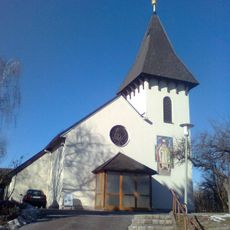
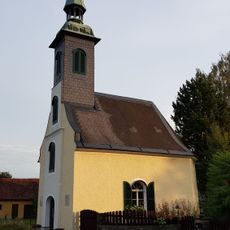
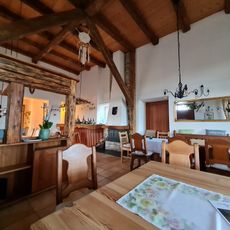
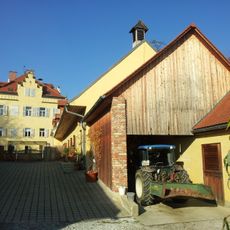
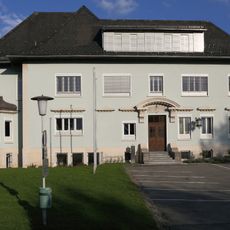
Graz-Lustbühel satellite station, Satellite observatory in Waltendorf district, Graz, Austria.
Graz-Lustbühel satellite station stands on the Lustbühel ridge in Graz's ninth district, Waltendorf, and is Austria's fundamental station for cosmic and satellite geodesy. Its main instrument is a Zeiss BMK 75 satellite camera converted from photographic plates to CCD technology with TU Wien, now also used for asteroid observation and space-debris detection tests. A Satellite Laser Ranging unit, the third developed in Graz since the 1970s, was the first worldwide to break the 1-cm accuracy threshold.
The facility began in 1943 as a small astronomy observation station on land near Lustbuhel Castle. Over the following decades it was gradually expanded and modernized into a satellite tracking center with laser-based systems.
The station is run jointly by the University of Graz, Graz University of Technology and the Austrian Academy of Sciences, whose Institute of Space Research has been based in Graz since 1971. Since October 2021 the institute has been led by Christiane Helling and has grown to around 100 staff from twenty nations. Only the Satellite Laser Ranging group stayed on the Lustbühel hill after the academy opened the Victor Franz Hess Research Centre in Graz-Messendorf in 1998–2000.
The hilltop location provides unobstructed sky view, which is essential for accurate satellite observation work. Keep in mind this is an active research facility where access may be limited or require advance arrangement.
The facility operates a laser-ranging unit capable of measuring satellite distances with an accuracy of just a few centimeters. This precision makes it possible to detect even minute movements of the Earth's crust.
The community of curious travelers
AroundUs brings together thousands of curated places, local tips, and hidden gems, enriched daily by 93,722 contributors worldwide.