Schloss Ernstbrunn, Medieval castle in Ernstbrunn, Austria
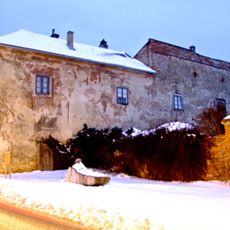
Schloss Ernstbrunn is a castle in Ernstbrunn, Lower Austria, built on a limestone cliff with steep slopes on several sides. The complex has four inner courtyards and sits within a large park that wraps around the main structure.
A Heinrich de Ernstbrunne appears as a witness in a Klosterneuburg charter around 1180, and the medieval core castle on its limestone spur dates from the 12th and 13th centuries. Rudolf Graf von Sinzendorf had the forecourt rebuilt in baroque form between 1672 and 1677, as his two-lion coat of arms over the round-arched portal shows. From the 1770s Prince Prosper von Sinzendorf expanded the complex into a palace, with Benedict Henrici as architect and sculptor and Jacobus Wanderl working on the interiors; the Sinzendorfs died out with him in 1822.
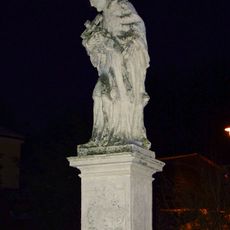
The castle has belonged to the Princely House of Reuss since 1828, when Heinrich LXIV of Reuss-Köstritz took over the estate after a long inheritance dispute; the family still lives there. In the garden, laid out in the second half of the 17th century, survive a temple fountain, a Nike column known as the "Schwarze Gretl", an obelisk honouring Field Marshal Gideon von Loudon and a monument to Chancellor Franz Josef von Saurau.
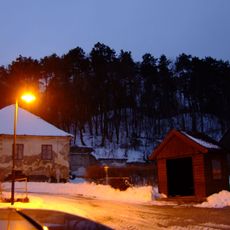
The castle stands in woodland northwest of Ernstbrunn's centre, above the hamlet of Dörfles, not in the town itself. It is a private residence of the Reuss family, so visits are limited to the exterior and the area around the gate. The baroque fountain with its 16 coats of arms stands just outside the gate.
The baroque fountain in front of the gate carries 16 coats of arms: four on the shaft below the basin and twelve in pairs around the rim of the hexagonal basin. They record the ancestors of Rudolf Count von Sinzendorf and Eva Susanna Countess von Zinzendorf and Pottendorf, the couple who built it.
The community of curious travelers
AroundUs brings together thousands of curated places, local tips, and hidden gems, enriched daily by 93,954 contributors worldwide.