Schloss Hagen, Former château site in Urfahr, Linz, Austria
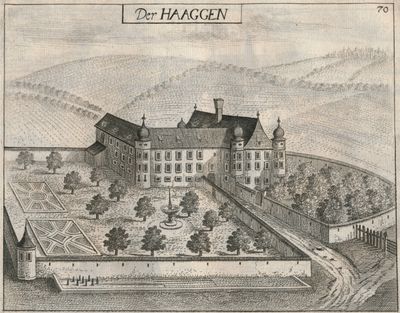
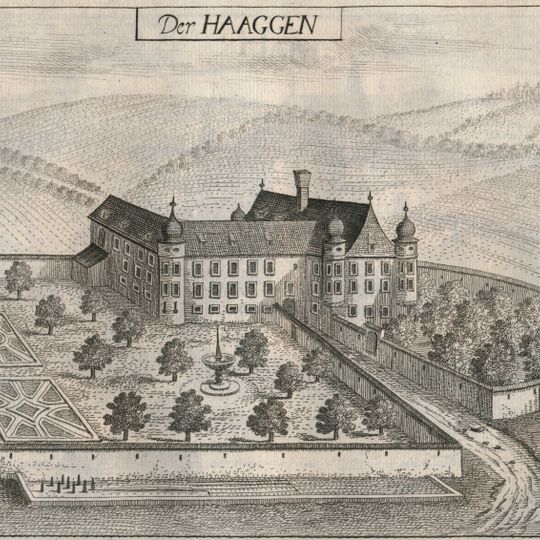
Schloss Hagen was a country estate at the foot of the Pöstlingberg in Linz's Urfahr district, demolished in 1963. A late 16th-century engraving by Georg Hufnagel shows a three-storey square building around an inner courtyard, with two corner towers and a further wing on the south-east side. Nothing of the structure survives today.
Schloss Hagen was first documented on 17 January 1414, when Reinprecht II von Walsee enfeoffed his servant Hanns Alt with the estate at the foot of the Pöstlingberg. Christoff Hackl acquired it in 1571 and replaced the farm with a new building. On 6 August 1609 Archduke Matthias raised it to a free noble estate, after which it was called Schloss Hagen. Damaged by bombs in World War II, it was demolished in 1963.
The name Hagen probably comes from the "Haken", a symbol resembling a mirrored one carved on stones in stone circles; other readings link it to "Gehacke" (felled wood for defence), "Gehege" (livestock enclosure) or the Hagenbuche tree. Older spellings were Haaggen, Haggen and Hakken. From 1609 the owners Barbara Bischof and her heirs were allowed to call themselves "von Haggen".
The château no longer stands: it was demolished in 1963, so there is no building to visit at the foot of the Pöstlingberg in Urfahr-Zentrum. What remains is the site and the documented history, best followed through local museums and archives in Linz.
The oldest known image of the estate is an engraving by Georg Hufnagel from the late 16th century. It shows a three-storey square building around a central courtyard with two corner towers, unusually solid for a rural estate of that time.
The community of curious travelers
AroundUs brings together thousands of curated places, local tips, and hidden gems, enriched daily by 92,882 contributors worldwide.