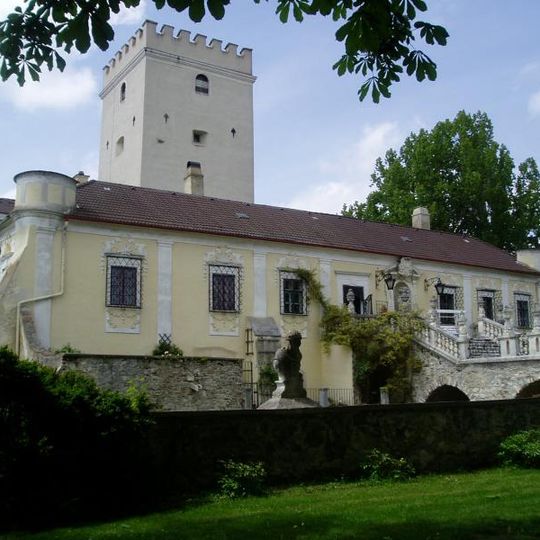
Schloss Harmannsdorf, Renaissance castle in Harmannsdorf, Austria
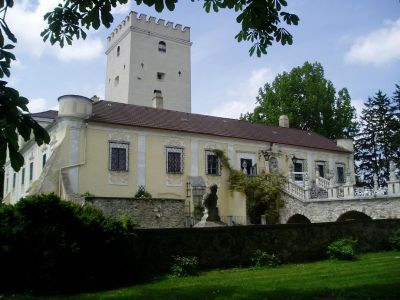
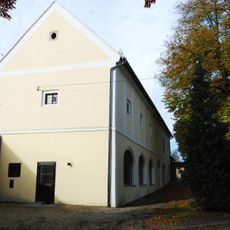
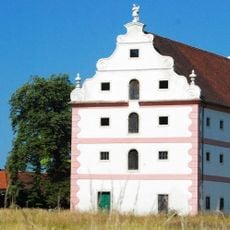
Schloss Harmannsdorf is a square, two-storey castle in the village of Harmannsdorf, built around a square courtyard and encircled by a deep former moat. It was converted into a moated castle in 1612, incorporating the medieval bergfried and other older parts. The west side is entered through a round-arched portal with the rollers of a former drawbridge in its spandrels, reached by a barrel-vaulted bridge with stone balustrades and flanking reclining lions.
Around 1280 a small fortification was documented in connection with a knight of Hadmarstorff. The Dachpeck held Harmannsdorf from 1415 to 1499, followed by the Grabner zu Rosenburg and rapid changes of ownership; in 1499 the seat was called "Höllturm" and marked the border junction of the Eggenburg, Gars and Horn courts. In 1612 the medieval bergfried and other parts were rebuilt into a moated castle.
The name Harmannsdorf derives from a knight named von Hadmarstorff, documented around 1280. In 1499 the seat was called "Höllturm" and marked the border point of the three district courts of Eggenburg, Gars and Horn. Bertha von Suttner, Nobel Peace Prize laureate, lived here from 1885 to 1902.
The castle is best reached by car, as it sits in a rural area near smaller villages in the Horn district. Walking around the surroundings is easy, since the terrain is flat and open.
The 1945 destruction of the fountain in the Turnierhof parterre is a detail visitors miss: Soviet troops turned the parterre into a football pitch. The 12 oversized statues and the field marshals' busts from Zogelsdorf sandstone were sold in 1964 and now stand at Schloss Neuaigen; the hedges were later cleared, leaving only a meadow.
The community of curious travelers
AroundUs brings together thousands of curated places, local tips, and hidden gems, enriched daily by 94,302 contributors worldwide.