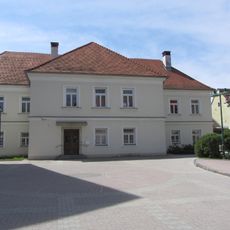
Schloss Hautzenbichl, Renaissance castle in Kobenz, Austria.
Schloss Hautzenbichl stands in the municipality of Kobenz, at the eastern edge of Knittelfeld. Joachim Muerer had the present building erected in 1542 in Renaissance style, reportedly by a French architect from the Loire, making it a copy of Loire château architecture. The facade still bears the coat of arms of Dompropst Maximilian Ernst Graf von Gleispach, who ordered extensive renovations in 1680.
Hautzenbichl was first documented in 1086, when Margrave Adalbero of Styria gave the estate "apud Huzinpuchli" to Archbishop Gebhard of Salzburg to lift a church ban, and the bishop passed it to Admont Abbey. Around 1150 it was a fortified court surrounded by walls and a moat, held by the lords of Hautzenbichl, and from 1160 it belonged to Seckau Abbey. Joachim Muerer had it rebuilt in Renaissance style in 1542, possibly by a French architect from the Loire, and in 1680 Provost Maximilian Ernst Count von Gleispach ordered extensive renovations. The fortifications were removed in 1735.
The coat of arms on the facade is that of Maximilian Ernst Graf von Gleispach, cathedral provost, who had the castle extensively renovated from 1680 and whose crest still marks the building. The estate has belonged to the Pranckh family since the line of the Grafen Vetter von der Lilie; Baroness Maria Pranckh, born 1932, is the present owner.
Schloss Hautzenbichl stands in the municipality of Kobenz, at the eastern edge of Knittelfeld, and is privately owned by the Pranckh family, so only the exterior can be seen. The grounds are used for pedigree dog breeding, so visitors should keep to public paths and not enter the property.
The estate grounds house a specialized breeding program for pedigree dog breeds. This modern purpose adds an unexpected dimension to the site beyond its historical role.
The community of curious travelers
AroundUs brings together thousands of curated places, local tips, and hidden gems, enriched daily by 93,802 contributors worldwide.