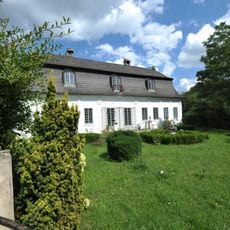
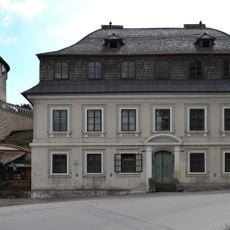
Schloss Leiben, Medieval castle museum in Leiben, Austria
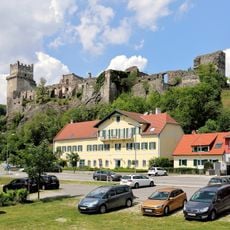
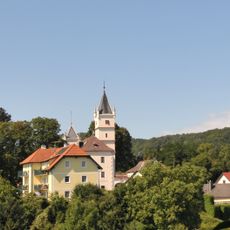
Schloss Leiben stands on a hill in the market town of Leiben in Lower Austria. Its main building is a four-storey structure of irregular plan with towers, built around a pentagonal arcaded courtyard with a clock tower and a second small inner courtyard. The Körnerboden wing and the vaulted cellar hold the agricultural technology museum.
The original castle was built around 1113 by the Knights of Leiben, who held it until 1332. In 1617 Hans Christian Geyer von Osterburg bought the estate and gave the building its present form. In 1796 it passed to the imperial family fund set up with part of the fortune of Emperor Franz I; from 1919 the Invalidenfonds administered it, from 1945 the Austrian Federal Forests, and in 1989 the market town of Leiben bought it.
The coffered ceilings in the Bet- und Rittersaal (prayer room and knights' hall) date from the 17th century and were carved by an unknown artist. Their panels show mythological and allegorical scenes alongside devotional religious images. The castle's name comes from the Knights of Leiben, who held the site from around 1113 until 1332.
The agricultural technology museum occupies four floors of the Körnerboden wing plus the vaulted cellar, about 1,000 m² in all. The castle stands on a hill above the market town of Leiben, in the Melk district of Lower Austria. Allow time for the cellars and the upper floors, where the scale collection is kept.
The museum opened in 1991, after the municipality bought the castle from the Austrian Federal Forests in 1989. It was first called "Traktorveteranenmuseum", renamed "Landtechnik-Museum" in 1994, and since 2019 has been called "Österreichisches Landwirtschaftsmuseum Europaschloss Leiben".
The community of curious travelers
AroundUs brings together thousands of curated places, local tips, and hidden gems, enriched daily by 94,028 contributors worldwide.