Garsten Abbey, Benedictine monastery in Garsten, Austria
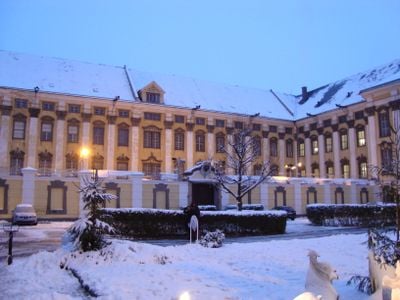
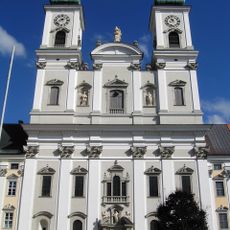
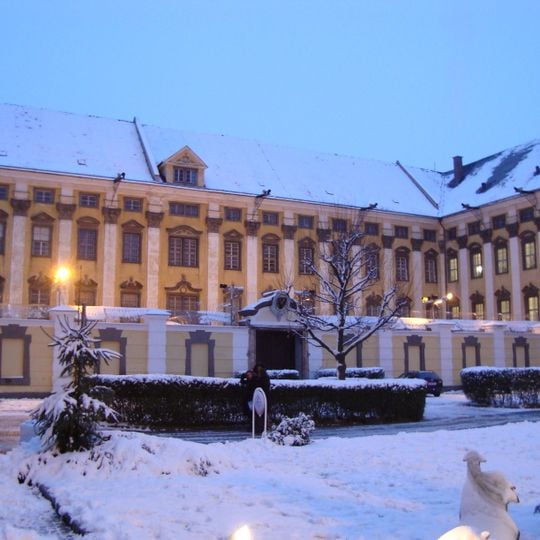
Garsten Abbey is a former Benedictine monastery in Garsten, Upper Austria. The long two-story building has a pale yellow facade with white pilasters, rows of dark-framed rectangular windows, and a steep snow-covered roof with dormer windows and a taller central gable above an arched entrance. Since 1851 the monastery buildings have housed Justizanstalt Garsten, a prison; the former abbey church, built by the Carlone family, serves as the parish church.
Ottokar II of Styria founded Garsten between 1080 and 1082 as a house monastery and burial place, first staffed by secular canons. In 1107 it became a priory dependent on Göttweig Abbey, and by 1110/11 an independent Benedictine abbey; the canons were forced to accept the change, one named Eberhard being bound and flogged until he complied. Abbot Berthold (1111–1142) made it the centre of the Eisenwurzen. Joseph II dissolved the abbey in 1787, and since 1851 the buildings have held a prison.
The parish church keeps Dutch tapestries that are hung with Lenten cloths painted by Kremser Schmidt during Advent and Lent. The Losenstein chapel holds the burial place of the Losenstein family, and the Berthold organ was consecrated on 8 December 2009 after rebuilding by Rudolf von Beckerath Orgelbau, reusing two roughly century-old cases by Franz Hölzl.
A Christmas market operates seasonally on the Am Platzl Square and offers a natural entry point for visitors to explore the grounds. Accessibility is limited since parts of the compound remain an active prison facility.
The monastery theatre was dismantled in 1789 and transported to Steyr, where it was rebuilt as a town theatre. This stage became an important cultural gathering place for the region before eventually being converted into a music school.
The community of curious travelers
AroundUs brings together thousands of curated places, local tips, and hidden gems, enriched daily by 93,806 contributors worldwide.