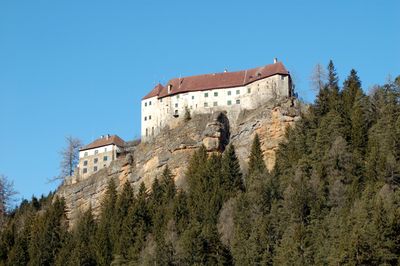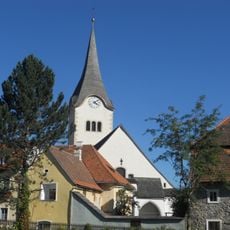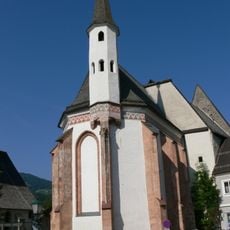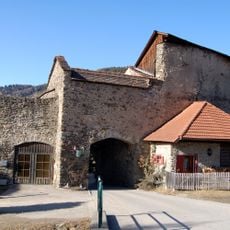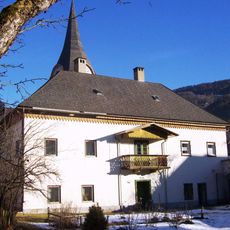
Schloss Rothenfels, Medieval castle in Oberwölz, Austria.
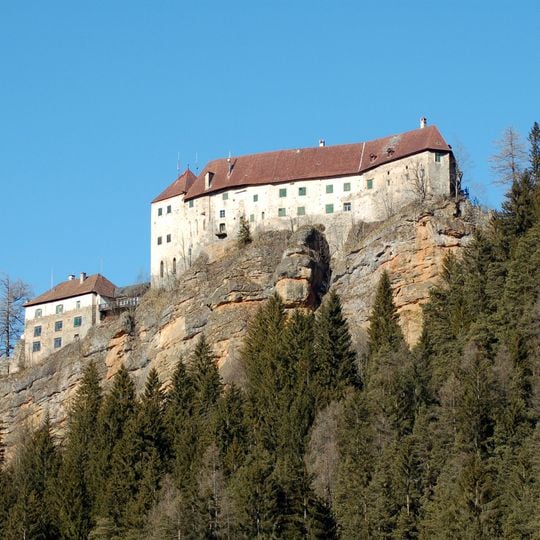
Schloss Rothenfels is a medieval rock castle on a reddish iron-bearing rock about 100 metres above Oberwölz. It consists of the oldest citadel on the rock and an outer ward slightly below, with a water basin in the citadel courtyard. Its parts result from rebuilds between the 14th and 17th centuries, and from the south it stands above a sheer cliff while a barely sloping plain leads up from the opposite side.
First documented in 1007, the castle served as an administrative center for the Prince-Bishop of Freising until 1803, making it part of a nearly 800-year governance tradition. This extended period of religious authority shaped both the building's purpose and its development over time.
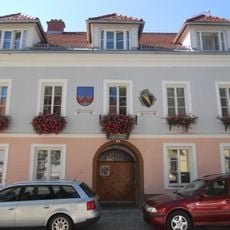
The castle's name comes from the reddish, iron-bearing rock it stands on; it was earlier called Wölz after the valley. The Mohr in the coats of arms of both castle and town of Oberwölz derives from the Bishopric of Freising, which held the Wölzertal from 1007 to 1803. A chapel stood by the gate, enlarged around the mid-14th century and endowed with estates; its revenues supported a priest, the so-called Caplanay im gschloss Rothenfels.
The castle stands on a reddish iron-bearing rock about 100 metres above Oberwölz, with a steep southern rock face and a gently sloping plain on the opposite side. It is privately owned and maintained by the Steiner family from the income of its forest estate, so visits depend on the owners' arrangements rather than fixed opening days.
The castle core retained its medieval appearance over the centuries, which is rare since most fortresses underwent later renovations. This original character makes it valuable for visitors interested in authentic medieval architecture without modern alterations.
The community of curious travelers
AroundUs brings together thousands of curated places, local tips, and hidden gems, enriched daily by 92,850 contributors worldwide.