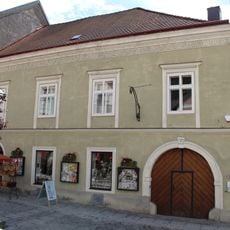
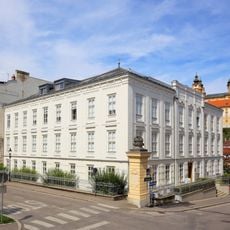
Villa Loos, building in Melk, Austria
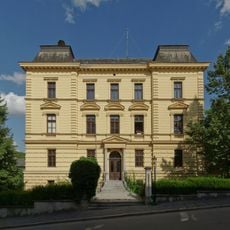
Villa Loos is a residence built in 1901 and designed by architect Josef Plečnik for notary Hans Loos von Losimfeldt in Melk. The building displays a mix of textures with smooth and rough surfaces, decorated tiles in blue and beige tones, brickwork, and Eternit panels arranged in geometric forms.
Villa Loos was designed in 1901 by Josef Plečnik, a student of the Wagner school, and reflects the shift from traditional styles to modern architecture. Painter Ernst Stöhr, a co-founder of the Vienna Secession, used the house's attic studio before World War I as a meeting point for artistic and cultural exchange.
Villa Loos earns its nickname "Tile Villa" from the decorative tiles that cover parts of its exterior, showing the craftsmanship of the early 1900s. The house served as a gathering spot for artists of the time, especially after painter Ernst Stöhr set up his studio in the attic and attracted visitors connected to the Vienna Secession.
Villa Loos stands at Abt-Karl-Straße 16, in the Gründerzeit villa quarter around Abt-Karl-Straße. The house is privately used and not open to visitors; the street front lets you see the façade materials from outside. The nearest train station is Melk, about a 15-minute walk away.
The nickname "Tile Villa" comes from the glazed ceramic tiles in blue and beige that Plečnik set into the facade alongside smooth plaster, rough plaster, brick and Eternit panels. The house is a listed monument, so the exterior is what a visitor sees; the material mix is best read from the street, where the tiles catch the light differently from the plaster around them.
The community of curious travelers
AroundUs brings together thousands of curated places, local tips, and hidden gems, enriched daily by 94,302 contributors worldwide.