Schloss Schönwörth, Medieval castle in Langkampfen, Austria
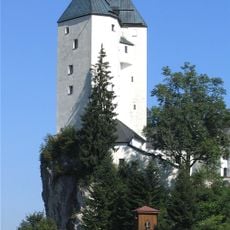
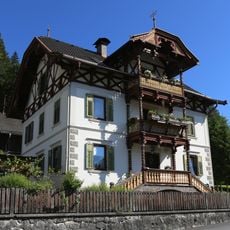
Schloss Schönwörth is a five-storey brick residential tower in Niederbreitenbach, part of Langkampfen, with walls up to 1.2 m thick and a Krüppelwalm roof. Prince Alexander Baratinsky added a round stair tower, a veranda, carriage sheds, stables and servants' quarters, and laid out a park; stone lions at the entrance and coats of arms on the windows recall the Löwenstein family.
The tower was first documented in 1448, when Duke Heinrich of Bavaria sold it to Hans Ebbser, keeper of Kufstein; it was probably built around 1360 by the Lords of Freundsberg. The name Schönwörth comes from a Schurff residence in Volders destroyed by lightning in 1747, and the Schurffs kept the title 'Freiherren von Schönwörth' until 1688. In 1834 the estate passed to peasant ownership, and in 1858 the cement manufacturer Alois Kraft bought it.
The name Schönwörth comes from a Schurff family seat in Volders that was destroyed by lightning in 1747; the Schurffs kept the title "Freiherren von Schönwörth" until the line died out in 1688. Stone lions at the entrance and coats of arms on the windows recall the Löwenstein family, who owned the castle from 1906.
The property is privately owned and not regularly open to visitors. Information about possible visits can be obtained through the Langkampfen municipal administration.
The stone lions at the entrance and coats of arms in the window frames recall the Löwenstein family: Hubertus Prinz zu Löwenstein, later a politician and writer, was born here in 1906, the year his father Max zu Löwenstein-Scharfeneck bought the estate.
The community of curious travelers
AroundUs brings together thousands of curated places, local tips, and hidden gems, enriched daily by 94,149 contributors worldwide.