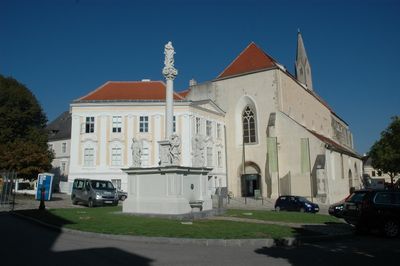
Dominikanerkirche Krems, Abbey church and museum in Krems, Austria.
Dominikanerkirche Krems is a former Dominican church with a three-aisled, five-bay nave and a four-bay choir with a 5/8 polygonal apse. The plain facades show elements from late Romanesque to Gothic, and a slender roof turret rises above the choir. The nave opens through pointed arcades to lower side aisles; the 1960s restoration removed the inserted ceilings and partitions.
The Dominicans received a plot outside the city walls in 1236; construction of the church began around 1240 and was documented in 1244, with the nave finished around 1260/1265 and the choir around 1320/1330. After a fire in 1410 and use as a powder store that exploded in 1566, the friars returned in 1586 and built a crypt beneath the choir. Josephinian reforms ordered the monastery dissolved in 1783 and the church was secularized in 1786; in 1790 nave and choir were structurally separated, the choir serving as a city theatre from 1794 and a cinema from 1921, while the nave became a granary, then a fire station depot in the 1880s and a city museum from 1891.
The church is dedicated to Saints Peter and Paul. Its most notable artwork is a large Gothic wall painting of about 1280 in the nave, 3.5 by 4.4 metres, showing the Last Supper, the Crucifixion and the Coronation of Mary; an inscription names Gozzo von Krems as donor. Much of the Baroque furnishings, including the high altar and a 1734 Rosary Queen by Josef Matthias Götz, were moved to the parish church of Tautendorf.
The former church stands in Krems an der Donau, in Lower Austria. Since 2011/2012 the nave and choir have served the Landesgalerie für zeitgenössische Kunst for temporary exhibitions held in summer. The nave and choir were structurally separated in 1790, so expect two distinct rooms rather than one continuous space.
The roof tiles over the choir were already old when the roof frame was built: analysis in Canada dated them to the mid-14th century, making them the oldest known roof tiles in Austria. The church also keeps a monumental wall painting of the Austrian Jagged style, 3.5 by 4.4 metres, donated by Gozzo von Krems and dated around 1280.
The community of curious travelers
AroundUs brings together thousands of curated places, local tips, and hidden gems, enriched daily by 93,069 contributors worldwide.