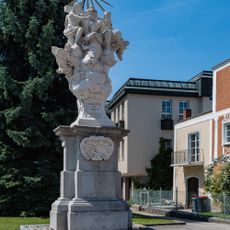
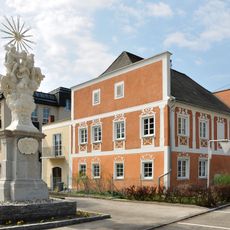
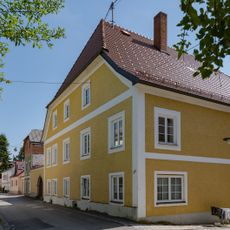
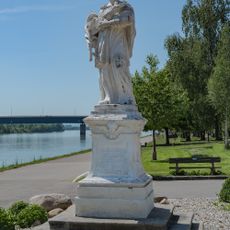
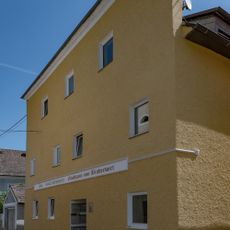
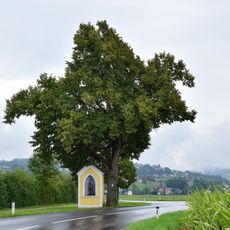
Schloss Bergheim, Protected château in Feldkirchen an der Donau, Austria.
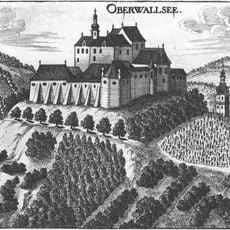
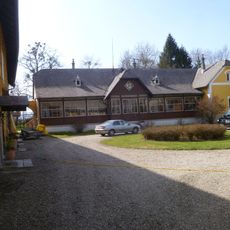
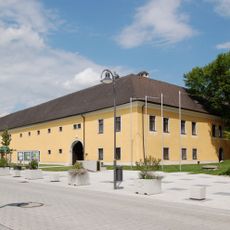
Schloss Bergheim is an irregular, multi-winged castle complex in a broad park landscape in Feldkirchen an der Donau. Its oldest parts date from the 15th century; a 1674 engraving by Georg Matthäus Vischer shows a three- to four-storey, three-winged building enclosed by a wall and a moat. The moat was drained in the 16th and 17th centuries and the building extended northward. The present appearance dates from the 1867/68 rebuilds, which added the arcaded Wappengang with coat-of-arms reliefs of all owners and a neo-Rococo festival hall on the first floor. Some stucco ceilings and a Baroque staircase survive.
Bergheim is first documented in 1111 as Bercheim; around 1160 Engelbert von Blankenberg gave a manor there to the St. Nikola monastery near Passau. In 1415 Thoman Geizerstätter sold the seat to Stephan Kammerer von Kammerhof, and by 1635 it passed through Christine Kammerer's dowry to Karl Fieger von Hirschberg, under whom it was rebuilt as a country palace. From 1921/22 a household school for farm girls operated here, reopened in 1946 as an agricultural household school.
The name Bergheim goes back to the 1111 mention of "Bercheim"; the noble seat "Perkchaim" appears in 1415. From 1921/22 a household school for farm girls operated here, followed in 1938 by a one-year rural women's school. The building later served as a primary school, kindergarten and refugee quarters, and since 1946 again as an agricultural household school.
The castle stands at Bergheimer Straße 7 in Feldkirchen an der Donau, in the Urfahr-Umgebung district of Upper Austria. Teaching at the Fachschule Schloss Bergheim is expected to continue only until summer 2025, and no decision on later use has been made, so access should be confirmed before a visit. The grounds were sold in 2000 to Hans Arthofer of Hartkirchen, who leased most of the land to local farmers.
The arcaded Wappengang in the 1867/68 extension displays reliefs of the coats of arms of every owner of Bergheim, from the Kammerers to the Starhembergs and Pereira-Arnstein. The neo-Rococo Festsaal on the first floor and several stucco ceilings also date from this rebuilding under Viktor von Pereira-Arnstein.
The community of curious travelers
AroundUs brings together thousands of curated places, local tips, and hidden gems, enriched daily by 94,441 contributors worldwide.