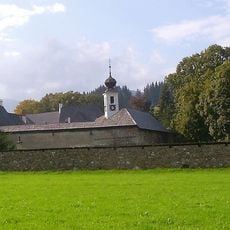
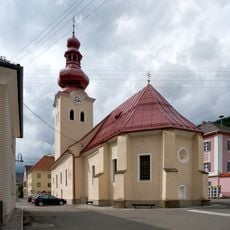
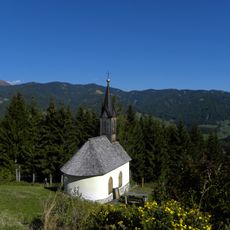
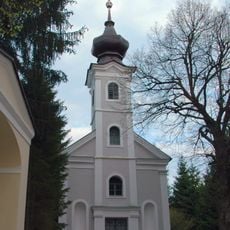
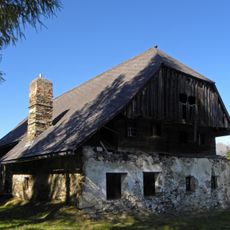
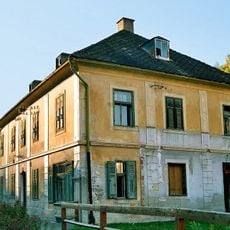
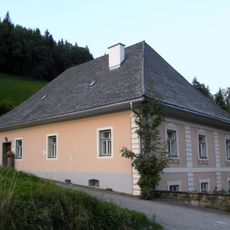
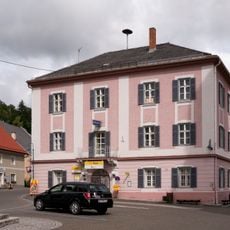
Schloss Hanfelden, Renaissance castle in Pölstal, Austria.
Schloss Hanfelden is a Renaissance castle in the Pölstal with four wings spanning three stories that enclose an arcaded courtyard with ornate architectural details from different construction periods. The structures display features from various phases of renovation and show how a defensive fortress evolved into a residential palace.
Caspar Han, toll collector at the Triebener Tauern, may have begun a residence around 1410, giving the site its name. In 1494 Hans Han the Younger, enfeoffed by King Maximilian I, rebuilt a derelict farm; Maximilian is documented at Unterzeiring in October 1506. The Han family sold to Hans Rauchenberger in 1579, who gave the building its early Baroque form. After the Protestant Rauchenbergers left in 1629, ownership changed often and the castle was dilapidated by the early 18th century; Franz Xaver Neuper bought it in 1856, and his descendants still own it.
The castle's name comes from the Han(n) family, toll lessees at the Triebener Tauern, who built the seat here; Hans Han the Younger was enfeoffed with the estate by King Maximilian I and began rebuilding in 1494. The Maximiliansstube takes its name from an inscription carved about a century after Maximilian's stay, recording the king's visit to Zeiring; tradition also holds that he lodged at Hanfelden for three months around 1475 to oversee work on the flooded silver mine at Oberzeiring.
Schloss Hanfelden stands in Unterzeiring, part of the Pölstal municipality in the Murtal district of Styria, at about 983 metres above sea level. The building is privately owned by the descendants of Franz Xaver Neuper, who bought it in 1856, so visits are not generally open to the public. The surrounding slopes rise toward the 1,397-metre summit about a kilometre to the north.
Since 2016 the University of Vienna's Institute for Prehistory and Historical Archaeology, led by Prof. Claudia Theune, has studied the castle with the interdisciplinary Arbeitskreis Schloss Hanfelden. Dendrochronology and building research suggest the first residential tower may date only from around 1500, so the older structure in written records was probably an abandoned farmstead. The digs are research work, not a visitor excavation site.
The community of curious travelers
AroundUs brings together thousands of curated places, local tips, and hidden gems, enriched daily by 92,868 contributors worldwide.