Kleeberg, Mountain summit in Styria, Austria
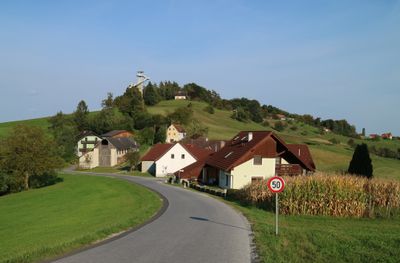
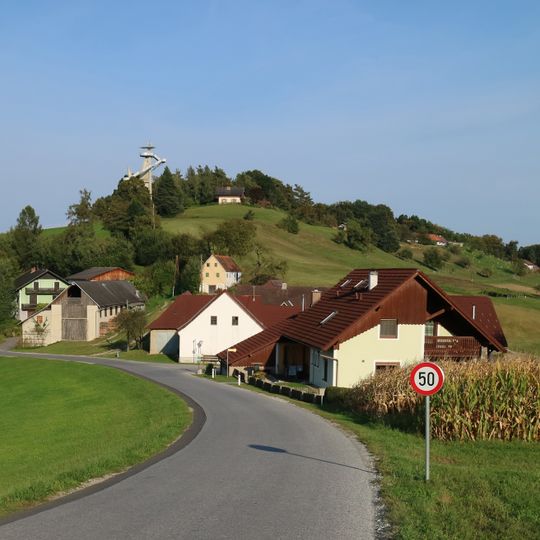
Kleeberg is a 499 m hill in the Styrian Neogene basin, about four kilometres south of Gleisdorf on the border between Labuch and St. Margarethen an der Raab. A 32-metre viewing tower of two opposed concrete triangles, designed by sculptor Gottfried Höfler, stands a few metres northwest of the highest point at 492 m. Its 140-step stairway links the two parts, with platforms at 15 and 25 metres.
The Kleeberg's modern history centres on its 32-metre viewing tower, built by the municipality of Labuch between September 2001 and March 2002 with support from St. Margarethen an der Raab. Designed by sculptor Gottfried Höfler and realised by architect Johann Wahlhütter, it was rotated 180 degrees from the approved plans, prompting a 2008 court-ordered closure. After a further closure in March 2015, an agreement between residents and the Gleisdorf council led to its reopening on 24 September 2017.
The Kleeberg is known for its 32-metre viewing tower, built between September 2001 and March 2002 by the municipality of Labuch with support from St. Margarethen an der Raab. Sculptor Gottfried Höfler designed the structure, which architect Johann Wahlhütter realised as two opposing concrete triangles linked by a 140-step staircase.
Hikers can reach the summit using well-marked trails from several starting points, with most routes offering moderate difficulty. The paths are well-maintained throughout the year, though sturdy footwear and weather-appropriate clothing are important for the altitude.
The 32-metre lookout tower on the hill was built in 2001–2002 to a design by sculptor Gottfried Höfler, realised by architect Johann Wahlhütter. It consists of two opposed concrete triangles linked by a 140-step stair, the last 10 metres of which are suspended. About 300 residents had protested against the 350,000-euro structure before construction began.
The community of curious travelers
AroundUs brings together thousands of curated places, local tips, and hidden gems, enriched daily by 94,905 contributors worldwide.