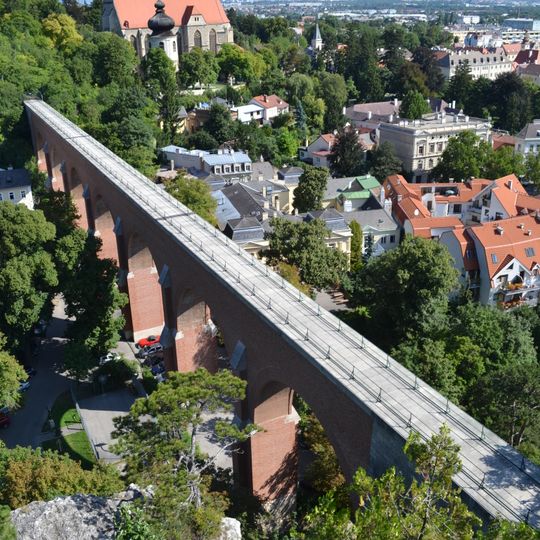
Aqueduct / Aquädukt Mödling, Historic aqueduct in Mödling, Austria.
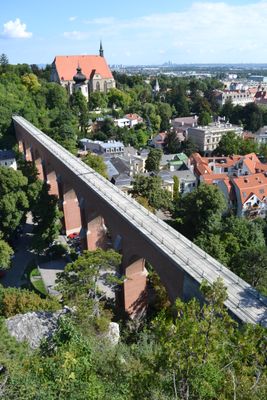
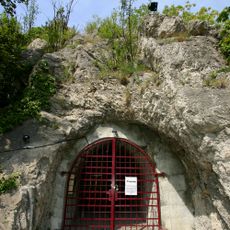
The Aquädukt Mödling is a 190-metre-long valley crossing over the Mödlingbach and part of the town, built from 1870 and completed on 14 November 1872. Seven arches of about 17 metres span each carry the water conduit at a clear height of roughly 24 metres, with a maximum total height of about 28 metres. The outermost arches rest directly against the rock walls, and the pipeline tunnels of the First Vienna Mountain Spring Pipeline join immediately at both ends.
The structure was built in the late 19th century and formed part of the First Vienna Mountain Spring Pipeline, which supplied fresh water to the growing population. This pipeline marked a turning point in the region's water supply infrastructure.
The aqueduct carries the First Vienna Mountain Spring Pipeline over the Mödlingbach and part of the town, and both ends connect directly to the pipeline's tunnels. Its seven arches, each about 17 metres wide, with the outer ones set against the rock walls, make it a landmark of Mödling's townscape.
The aqueduct spans the Mödlingbach valley within the town, with the outermost arches set against the rock walls at both ends. The structure is viewed from outside; the pipeline tunnels of the First Vienna Mountain Spring Pipeline connect directly at each end. The masonry was renewed between 1999 and 2004 with frost-resistant clinker bricks in the old Viennese format.
The 1999–2004 renovation, developed by Vienna's waterworks (MA 31) with the Federal Monuments Office, cut about 15 cm of damaged masonry off the outer face with a diamond wire and replaced it with frost-resistant clinker brick in the old Viennese format. The same method was later used on the Speising aqueduct in Liesing until October 2006.
The community of curious travelers
AroundUs brings together thousands of curated places, local tips, and hidden gems, enriched daily by 94,302 contributors worldwide.