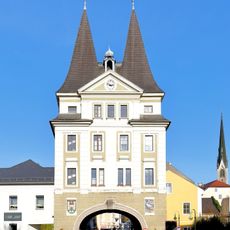
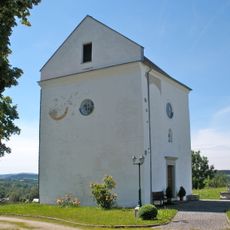
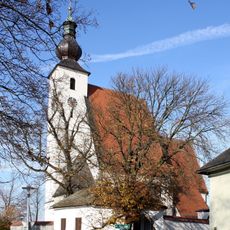
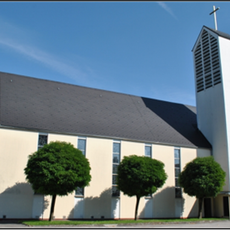
Pfarrkirche Schwanenstadt, Protected heritage church in Schwanenstadt, Austria.
Pfarrkirche Schwanenstadt is a neo-Gothic hall church built 1900–1902 to plans by Paul Hochegger, executed by architect Matthäus Schlager. It stands south of the town square, measures 52 m long and 35 m wide, and its granite columns support a 17 m vault. The roughly 80 m tower with steep spire is the town's landmark.
The parish was first mentioned in 1291 as the centre of a large mother parish that included Atzbach, Rüstorf and Desselbrunn. A crypt under the choir survives from an 11th- or 12th-century Romanesque church, damaged in the 1554 market fire and rebuilt as a hall church. The present neo-Gothic building was erected from 1900 to 1902 to plans by Paul Hochegger, executed by architect Matthäus Schlager; the foundation stone was laid on 16 September 1900 and Bishop Franz Maria Doppelbauer consecrated it on 19 July 1902.
The church displays neo-Gothic styling with crafted details from the early 1900s. The interior makes an impression through its three-nave layout and the carved high altar showing a life-sized scene.
The church stands south of the town square, not at its centre; the roughly 80-metre tower with its steep spire is visible from afar. The interior is about 960 m², with a 17-metre central vault and granite columns. The south outer wall preserves a badly damaged late-Gothic Mount of Olives relief from around 1500, and 16th- to 18th-century gravestones are set on the exterior of the choir.
Inside sits a pneumatic organ from 1905 with 37 registers, considered one of Josef Mauracher's largest instruments made. The organ received a full restoration in 1995 while keeping its original sound character.
The community of curious travelers
AroundUs brings together thousands of curated places, local tips, and hidden gems, enriched daily by 95,039 contributors worldwide.