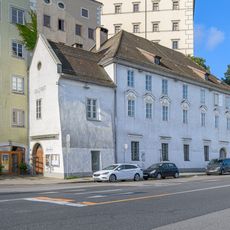
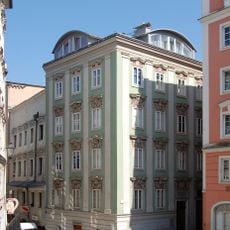
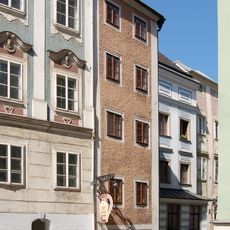
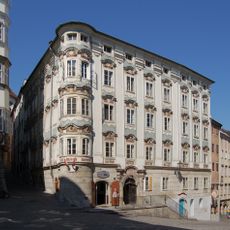
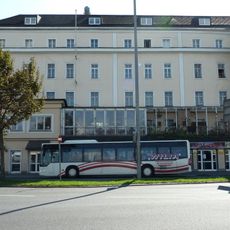
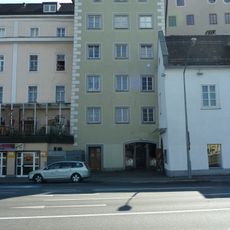
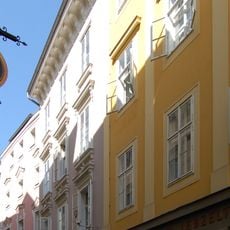
Heinrich-Gleißner-Haus, Protected architectural monument on Obere Donaulände, Linz, Austria.
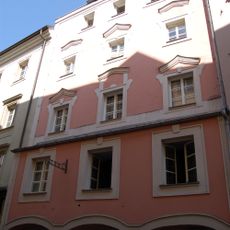
The Heinrich-Gleißner-Haus is a neoclassical building at Obere Donaulände 7–9 in Linz, built in 1939 to plans by Roderich Fick. Its high ground floor is faced in massive granite ashlar with a round-arched entrance, and the facade is articulated only by sparing segmental pediments above the windows. Above the top floor rises the Pegelturm, a water-level gauge tower, not an observation tower.
The building was constructed in 1939 as a waterway administration office, reflecting the bureaucratic structures of that era. In 1952 it acquired a new role as a political party headquarters, linking its original purpose to institutional importance.
The building is named after Heinrich Gleißner, Upper Austrian governor, and has housed the state branch of the ÖVP since 1952. The name was given in his honour; the party has owned the building since 1984. The Pegelturm above the roof is a river gauge tower, not a lookout point.
The building is situated at Obere Donaulände 7, directly beside the west approach building and forms a connection to Linz's old town. Its location right along the Danube makes it easily accessible and provides good orientation for understanding the area's layout.
The Pegelturm above the roof is a water-level gauge tower, not an observation tower, and it recalls the building's origin as the Wasserstraßenamt. The granite ground floor with its round-arched entrance was already part of Roderich Fick's 1939 design.
The community of curious travelers
AroundUs brings together thousands of curated places, local tips, and hidden gems, enriched daily by 94,560 contributors worldwide.