Schloss Ebergassing, Protected castle in Ebergassing, Austria
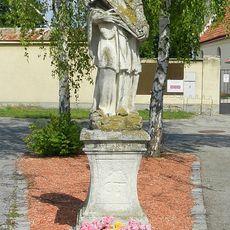
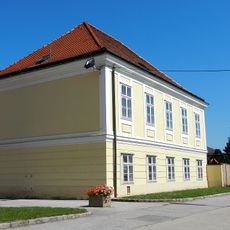
Schloss Ebergassing stands in the eastern part of Ebergassing in Lower Austria, a former moated castle fed by the Fischa. Its irregular four-sided building, three storeys high, encloses a trapezoidal courtyard; the main front faces southeast with a recess in which the chapel choir projects northeast. A large clock tower rises above the roof, and a masonry bridge flanked by baroque pedestals leads to the entrance.
A castle at Ebergassing is documented in 1120, and around 1136 a Hezilo von Ebergozzingen appears. In 1486 Hungarians with Viennese mercenaries took it after a long siege. Between 1540 and 1620 the Thanrädl family rebuilt the medieval fortification as a Renaissance water castle; after the Protestant revolt of 1619/1620 it was confiscated on 7 October 1620 and passed to the Liechtenstein princes, who expanded it in Baroque phases around 1720 and 1760.
The castle chapel, whose core the lords of Wald rebuilt in the 15th century, holds a grave slab of that family; since 23 November 2023 it has been canonically established under the patronage of Saint Ulrich of Augsburg. The chapel is not open to visitors, as the grounds are privately used.
The grounds are privately used and not open to the public, so the castle can only be seen from outside. Access to the grounds is via a masonry bridge flanked by baroque pedestals. The chapel awaits renovation; the main and side buildings were divided into flats, with the attic converted for that purpose.
A stone bridge spans the former moat, which once received water from the Fischa River and protected the fortified structure. Baroque pedestals at the castle gate still mark this historic entrance today, showing artistic refinement after the defensive era.
The community of curious travelers
AroundUs brings together thousands of curated places, local tips, and hidden gems, enriched daily by 95,021 contributors worldwide.