Kaiser-Max-Grotte, Wall cave in Zirl, Austria.
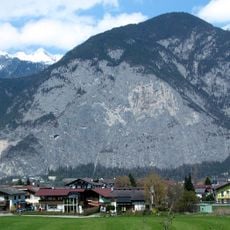
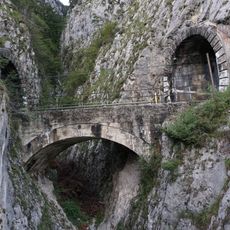
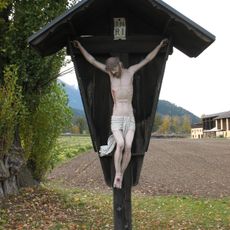
The Kaiser-Max-Grotte is a wall cave in the Martinswand, about 200 metres above the valley floor near Zirl. The partly widened opening measures 46 metres wide and 19 metres high. Inside stand a monumental wooden crucifix and a kneeling, praying figure of Emperor Maximilian I, carved by Johannes Obleitner in 1936.
In 1484 Maximilian, then still king, was hunting chamois in the Martinswand and climbed onto a narrow ledge from which he could neither advance nor retreat. He held out there for two days and two nights before a peasant boy led him down to the valley by a hunter's path. The rescuer vanished in the crowd, and the emperor later had his stand widened into the cave.
The grotto's name recalls the 1484 hunt when Maximilian I was stranded on the Martinswand for two days and nights; a peasant boy led him down a hunter's path, then vanished in the crowd and became an angel in the legend. The emperor had his ledge widened into the cave, where a wooden figure by Johannes Obleitner (1936) shows him kneeling in prayer.
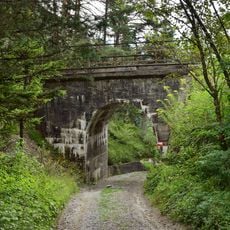
The path to the grotto begins at the parking area in Zirl and climbs steeply uphill. Plan for about one hour of walking and wear sturdy shoes, as sections of the trail can be demanding.
The grotto was widened on the orders of Maximilian I after his rescue, turning a narrow ledge into a cave 46 m wide and 19 m high. Sculptor Johannes Obleitner carved the kneeling emperor and the monumental crucifix in wood in 1936.
The community of curious travelers
AroundUs brings together thousands of curated places, local tips, and hidden gems, enriched daily by 94,492 contributors worldwide.