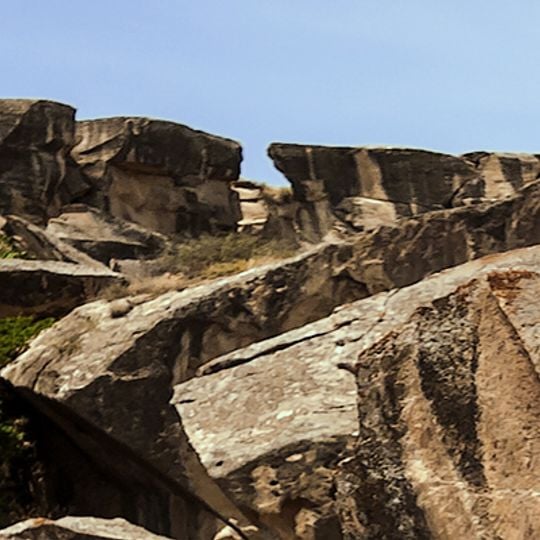
Gobustan National Park, Nature reserve and archaeological site in Absheron District, Azerbaijan.
Gobustan National Park covers 3,096 hectares of low rocky hills between the southeastern spurs of the Greater Caucasus and the Caspian Sea. Its beige and tan limestone formations rise in stacked, rounded masses with broad horizontal ledges and deep cracks. Around 6,000 petroglyphs, pecked and scratched into the rock, are concentrated on the plateaus of Beyukdash, Kichikdash, Jingirdag, Shongardag and Shikhgaya.
Archaeologist İshaq Cəfərzadə recorded about 3,500 carvings and signs on 750 rocks in 1939–1940, work interrupted by World War II and resumed in 1947. From 1965, an expedition led by C. Rüstəmov and F. Muradova examined more than 20 shelters and 40 burial mounds. The site became a state reserve on 9 September 1966 and joined the UNESCO World Heritage List in 2007.
The name Gobustan comes from Turkic 'qobu' (ravine) and 'stan' (land), meaning 'land of ravines'. Two gaval dash stones, natural ideophones at the foot of Chinqirdag and on Boyukdash, produce musical notes when struck. A Russian inscription at the main cave entrance records a visit by someone named Kruze in 1905.
The reserve covers 3,096 hectares of dry subtropical lowland crossed by ravines, with hot summers and mild winters. The main carvings are on the Böyükdaş and Kiçikdaş hills, where springs and wells fed by limestone groundwater lie on Böyükdaş. Rain often falls briefly in spring and autumn.
The site is known for Gaval Dash, a natural stone that produces musical notes when struck. This rare sound comes from the stone's unusual geological structure.
The community of curious travelers
AroundUs brings together thousands of curated places, local tips, and hidden gems, enriched daily by 93,600 contributors worldwide.


