Abbaye d'Andenne, Religious abbey in Andenne, Belgium
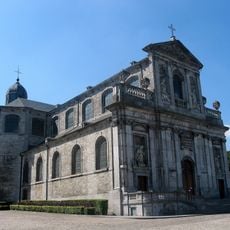
Andenne Abbey is a former monastic complex built from local limestone following classical architectural principles of the Meuse Valley region. The original structures were demolished in the 18th century, with their stones repurposed for the construction of the current neoclassical collegiate church that stands on the site.
Begga, daughter of Pepin of Landen and widow of Ansegisel, founded the monastery around 692. Father Anselme reports that Ansegisel, killed in a hunting party around 673–679, was buried there. The community was at first mixed and followed the Rule of Saint Benedict, then became a noble congregation of canonesses, confirmed by Emperor Henry IV in 1101 and Count Philip the Noble of Namur in 1207. In the 18th century it was a secular college for girls; its dilapidated churches were demolished with Empress Maria Theresa's permission, and the stones reused for a neoclassical collegiate church.
The monastery was initially a mixed Benedictine community but became an exclusive congregation of noble canonesses during the medieval period, where members followed strict religious rules.
The 18th-century neoclassical collegiate church, built with stones reused from the abbey's demolished churches, stands on the site; the domed tower with its small cross rises at one end of the roofline. The entrance block with its balustraded balcony faces the square, and low green hedges line the long side wall. Look for the statues in the facade niches and the tall arched windows in two levels.
The source mentions a study by Pierre Halleux, "Les sept Eglises de Ste Begge à Andenne", on the architecture of the seven churches of Saint Begge in Andenne. The founder's husband, Ansegisel, was killed around 673-679 during a hunt and, according to Father Anselme, was buried in the monastery.
The community of curious travelers
AroundUs brings together thousands of curated places, local tips, and hidden gems, enriched daily by 93,672 contributors worldwide.