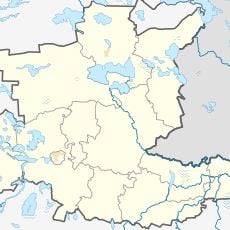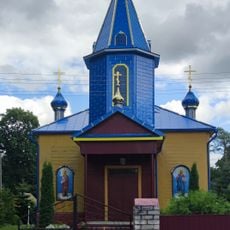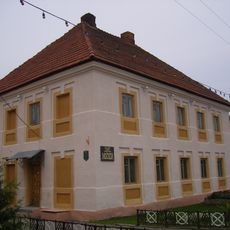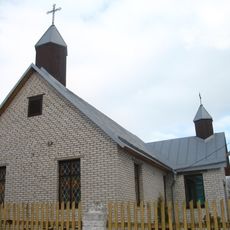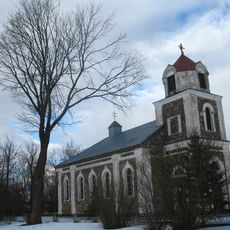
Church of Saint Anthony of Padua in Pastavy, Gothic Revival Catholic church in Pastavy, Belarus.
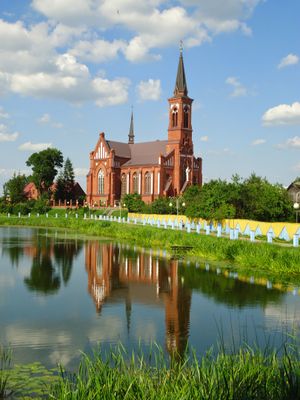
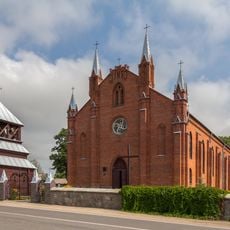
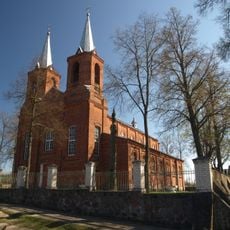
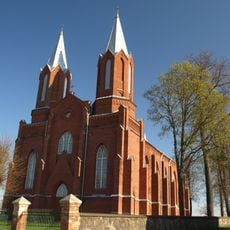
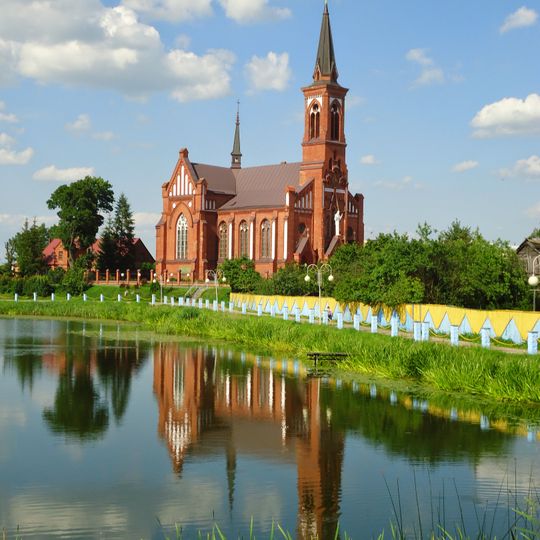
The Church of Saint Anthony of Padua is a three-nave neo-Gothic basilica of red brick, built on the foundations of a former Franciscan monastery church. It has a transept, a five-sided apse, two side sacristies and a tall tiled gable roof. Its main feature is a four-sided bell tower with a faceted spire above the central part of the main facade.
A wooden parish church was founded in Pastavy in 1516 by Yuri Zenovich; it was destroyed during the 1654–1657 war. The present red-brick church, designed by Artur Goebel, was built in 1898–1904 on the foundations of a former Franciscan monastery church, though sources also cite 1880–1887. Damaged in World War I and restored in the 1920s, it was closed in 1949, used as a grain store and later a factory, and returned to Catholics in 1988.
The parish traces its roots to 1516, when Yuri Zenovich founded a wooden church of the Mother of God. The Franciscan monastery begun in 1640 stood in the bend of the Myadzelka, and the present church was built on its foundations. Since 1988 the parish has been served by priests of the Congregation of the Sacred Heart of Jesus.
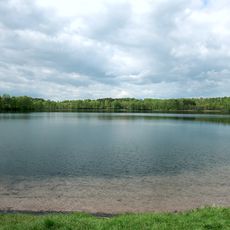
The church stands at 6 Naberezhnaya Street, in the bend of the Myadzelka River, and its 52-metre tower is reflected in Lake Pastavy. The building has a single tower, not twin towers. Two graves of Russian soldiers from the First World War and a symbolic tomb of priest Bolesław Maciejewski stand beside it.
The tower rises 52 m and is reflected in Lake Pastavy. Near the church are two graves of Russian soldiers from the First World War and a symbolic tombstone of parish priest Bolesław Maciejewski, shot by the Nazis in 1942. In 1988 it became the first church returned to worshippers in the USSR.
The community of curious travelers
AroundUs brings together thousands of curated places, local tips, and hidden gems, enriched daily by 94,127 contributors worldwide.