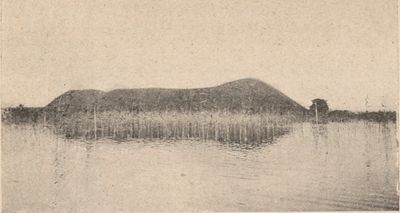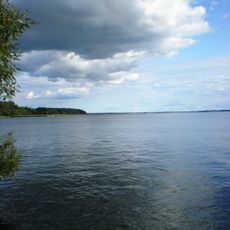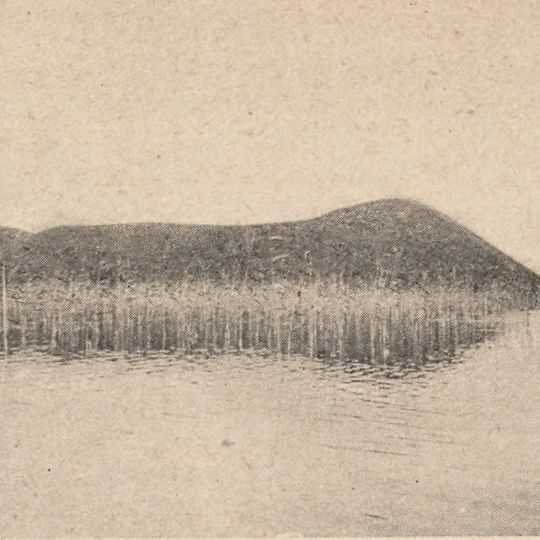
Drysviaty Castle, Medieval castle ruins on island in Lake Drysviaty, Braslaŭ District, Belarus.
Drysviaty Castle occupies the oval 75 by 50 metre summit of Zamok Island in Lake Drysviaty, raised 6–7 metres above the water and ringed by an earth rampart about 5 metres high on the island side and 1–1.5 metres on the lake side. The site today is a flat, overgrown hilltop with no standing walls; only the rampart and the castle site (zamchishcha) remain.
The castle stood from the 14th to the 17th century on Zamok Island in Lake Drysviaty, on a site used since the Dnieper-Dvina culture and Kievan Rus'. In 1514 it is first mentioned in written sources; from 1542 it belonged to Jan Hliebovich. A 1662 description records three roofless, sagging towers. It ceased to exist in the second half of the 17th century.
The castle gave its name to the island, Zamok, and to the small town of Drysviaty that stood beside it, with a market and three streets but no fortifications of its own. After a fire, the residents moved the town from the island to the eastern shore of the lake.
The castle site lies on Zamok Island in Lake Drysviaty, reached only by water; two bridges once linked it to the shore, but none remain. The oval platform, 75 by 50 m, rises 6–7 m above the water inside a ring rampart about 5 m high on the north and east sides and 1–1.5 m on the lake side. Excavations in 1955–56, 1970, 1976 and 1980 left the earthworks as the main visible feature.
The castle mound was raised four times between the 10th and 16th centuries, and its inner slope was paved with stones at each stage. Excavations by Leanid Alyakseyeu in 1955–56 and by Mikhail Tkachou in 1970, 1976 and 1980 uncovered this layered core.
The community of curious travelers
AroundUs brings together thousands of curated places, local tips, and hidden gems, enriched daily by 94,417 contributors worldwide.