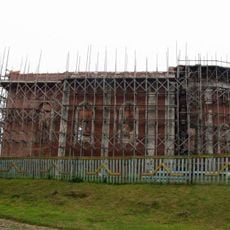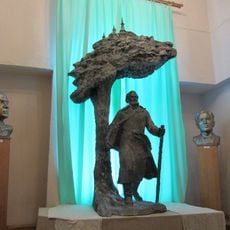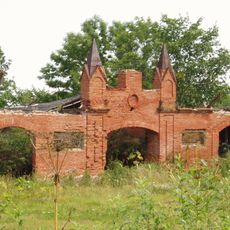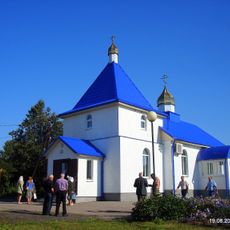
Yelnya Reserve, Landscape reserve in Vitebsk Region, Belarus.
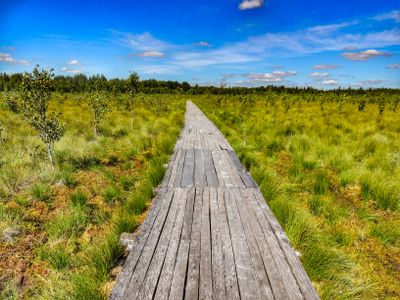
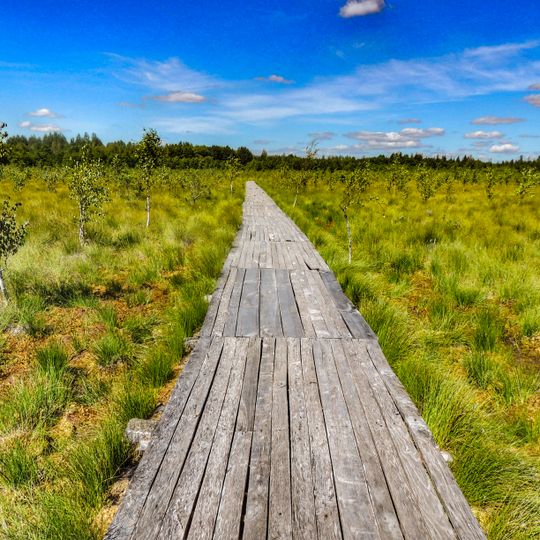
Yelnya Reserve is a raised bog on the second terrace of the Disna River in the Miory and Sharkawshchyna districts of Vitebsk Region. The peat massif, formed on the site of a former lake, is oval and flat with a centre rising 5–7 m above the surroundings; peat averages 3.8 m deep and reaches 8.3 m. Its 35 lakes, including Yelnya, Black and Dolhaye, cover 4.4% of the territory.
Yelnya was created in 1968 as a hydrological reserve to keep the Bolshoy Mokh bog massif and its vegetation in its natural state. It was enlarged in 1981 and joined the Ramsar list of wetlands of international importance in 2002. A Council of Ministers resolution of 27 December 2007 set its area at 25,301 hectares and changed its status from hydrological to landscape reserve.
The name Yelnya comes from Lake Yelnya, the largest of the reserve's 35 lakes, a shallow oligotrophic basin 3.5 m deep and 5.42 km² in area. The marsh occupies the bed of a former lake on the second terrace of the Disna, and its raised centre stands 5–7 m above the surrounding land. Birdlife draws visitors: about 50 pairs of cranes nest here, and the marsh is a stopover for birds migrating from the north to winter in Israel and North Africa.
The reserve lies in the Miory and Sharkawshchyna districts of Vitebsk Region, on the Polotsk Lowland. Its core is the raised bog Bolshoy Mokh, whose central dome rises 5–7 m above the surroundings and reaches 145 m above sea level. Access is by unpaved roads; the ground is peat, often waterlogged, and groundwater sometimes reaches the surface.
The moss layer holds 24 species, including Sphagnum molle and the liverwort Blepharostoma trichophyllum, both very rare in Belarus and Eastern Europe. The reserve also shelters dwarf birch (Betula nana) and cloudberry (Rubus chamaemorus).
The community of curious travelers
AroundUs brings together thousands of curated places, local tips, and hidden gems, enriched daily by 94,338 contributors worldwide.