Loyew Castle, Medieval castle in Lojeŭ, Belarus
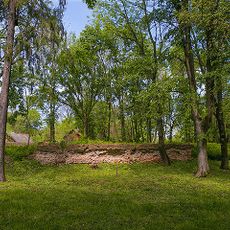
Loyew Castle was a medieval fortress on the right bank of the Dnieper in what is now the centre of Lojeŭ, opposite the mouth of the Sozh. It was built of wooden towers and walls on a semicircular plan about 125 m across, ringed by a rampart and a moat up to 2 m deep and 8 m wide. Its site was levelled in 1956 for the local House of Culture, and the filled moat can still be traced beneath the town's buildings.
The castle was built during the feudal period as a defensive stronghold in the region. It gained strategic importance during military conflicts of the 1600s that reshaped power dynamics across Eastern Europe.
The castle's name survives in the town's 2001 coat of arms and flag, which show a white Loyew Castle. The site itself was levelled in 1956 for the local House of Culture, so the castle now lives in Lojeŭ's civic symbols rather than in standing walls.
Nothing of the castle stands above ground: its area was levelled in 1956 for the local House of Culture, and the filled-in moat, up to 2 m deep, can still be traced beneath the town's present buildings. Look for the site in the centre of Lojeŭ on the right bank of the Dnieper, where the steep bank about 20 m high marks the eastern side.
The castle site was levelled in 1956 to build the local House of Culture, so nothing of the wooden towers and walls survives above ground. Archaeologists found Milograd culture hand-built pottery, 11th-13th century wheel-thrown ware including white-clay Kyiv-type vessels, glass bracelet fragments and slate spindle whorls on the eastern and southern slopes. The filled-in ditch, up to 2 m deep, can still be traced beneath the town's buildings.
The community of curious travelers
AroundUs brings together thousands of curated places, local tips, and hidden gems, enriched daily by 94,072 contributors worldwide.