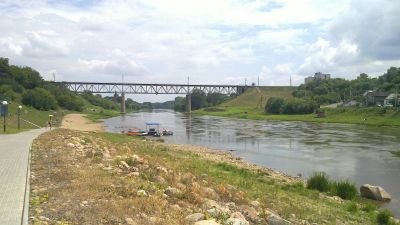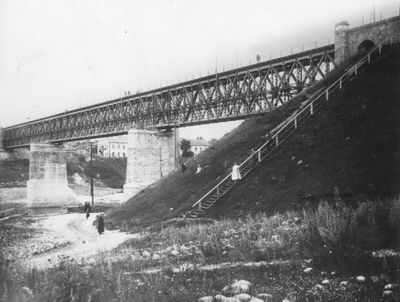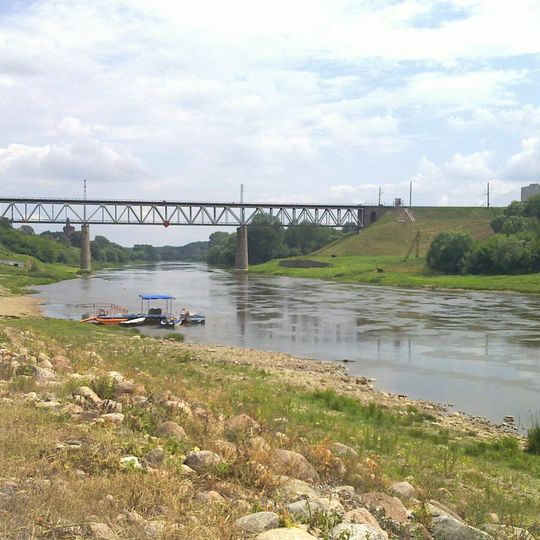
Railway bridge in Hrodna, Railway bridge across Neman River in Hrodna, Belarus.
The railway bridge in Hrodna is a steel structure spanning the Neman River and connecting both sides of the city with tracks that support regular train traffic. It handles international services throughout the year and forms an essential link in the railway network connecting Eastern and Western Europe.
The bridge opened in 1866 as part of the Warsaw–St Petersburg Railway, built for 200,000 rubles; work had begun in the 1850s and was halted in 1863 when engineer Captain Stolz joined the anti-Russian uprising. Russian troops blew it up in 1915, German sappers rebuilt it in wood within three months using about a hundred local workers, and it was destroyed again in 1920 during the battle for Hrodna, when a locomotive fell into the Neman. Rebuilt in the mid-1920s, it was blown up in 1941 and in 1944, then restored by the Soviet administration.
The bridge carries both wide 1520 mm and narrow 1435 mm gauge track, a legacy of the borderland where Russian and European gauges met. Its right-bank arch is a drive-through span, and the crossing links Podolnaya and Zbozhovaya streets. A German journalist in 1915 called the earlier bridge a "wondrous miracle of technology".
The bridge carries both wide 1520 mm and narrow 1435 mm gauges on its deck and approaches, so trains of either gauge can cross. It links Podolnaya and Zbozhovaya streets, and the arch span on the right bank is a road passage. The span is over 200 metres long, so the whole structure is best seen from a distance along the banks.
The bridge carries two gauges on the same deck: a 1520 mm broad-gauge track and a 1435 mm standard-gauge track, running across the span and its approaches. The right-bank arch is a drive-through arch, meaning trains pass through the opening rather than over it. The crossing links Podolnaya and Zbovaya streets.
The community of curious travelers
AroundUs brings together thousands of curated places, local tips, and hidden gems, enriched daily by 95,680 contributors worldwide.