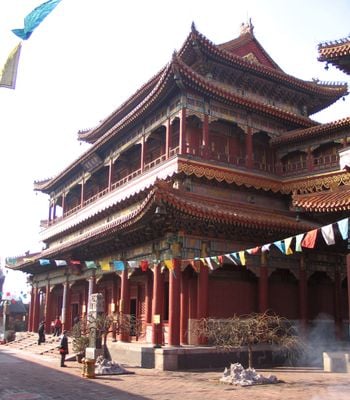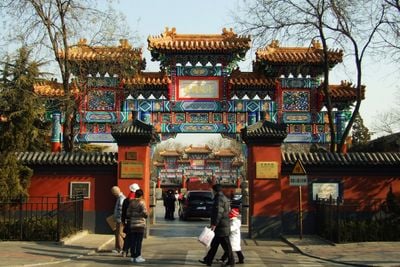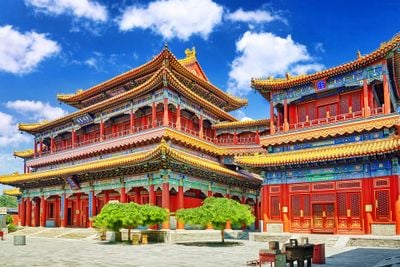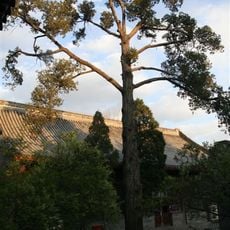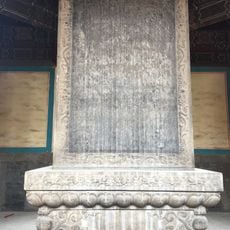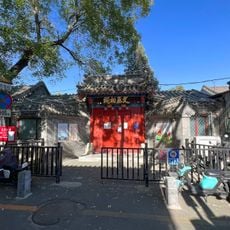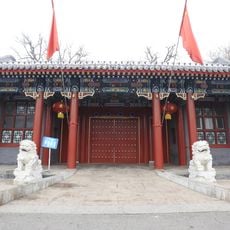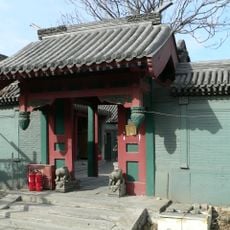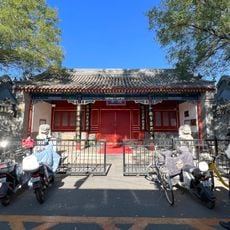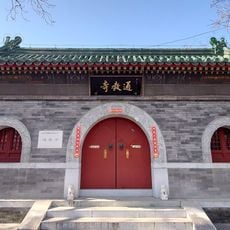
Yonghe Temple, Tibetan Buddhist temple in Dongcheng District, Beijing, China.
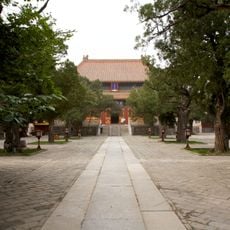
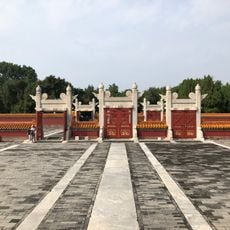
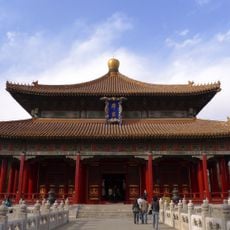
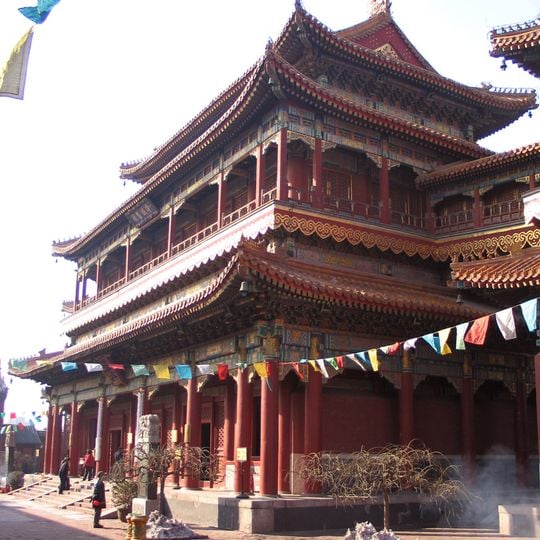
Yonghe Temple runs 480 metres north–south along a central axis, from the Gate of Clarity and Prosperity past five main halls. The Hall of the Wheel of the Law carries five Tibetan-style roof lanterns, one large and four small, standing for Mount Sumeru and the four continents. The Pavilion of Ten Thousand Happinesses, three storeys high, is linked to its flanking pavilions by elevated walkways.
The residence was built in 1694 for Prince Yinzhen, who later became Emperor Yongzheng. After his death in 1735, his son Qianlong converted the compound into a yellow hat monastery in 1744.
The name Yonghe means "Harmony and Peace"; the Tibetan name bestowed in 1744, Ganden Jinchalin, means "Tushita Splendid Continent." Each lunar twelfth month a large bronze cauldron beside the drum tower is used to cook laba porridge, which is distributed to visitors. The temple remains an active Gelug monastery, with monks resident and the abbot Lama Hu Xuefeng in office since 2010.
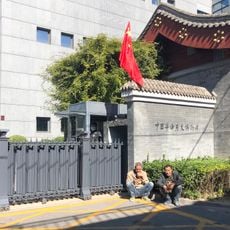
Yonghegong metro station sits directly outside the entrance, making arrival straightforward. The interior paths are mostly flat, though some halls have thresholds or steps.
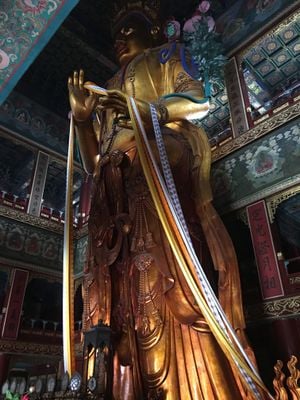
The Hall of Infinite Happiness holds a Maitreya Buddha figure carved from a continuous sandalwood trunk. The trunk was brought from Tibet to Beijing as a diplomatic gift in the 18th century.
The community of curious travelers
AroundUs brings together thousands of curated places, local tips, and hidden gems, enriched daily by 92,765 contributors worldwide.