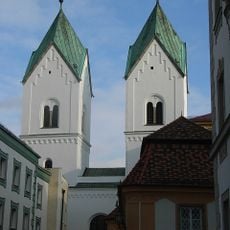
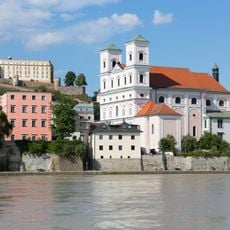
Collège jésuite de Passau, Religious convent in Passau, Germany
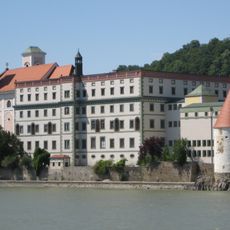
The Jesuit College in Passau is a building with a castle-like structure featuring a central tower, three main floors, and marble-clad staircases on the western side. The classical design combines spacious interior areas with an organized layout.
Founded in 1611 by Prince-Bishop Archduke Leopold of Austria, the structure was built in 1613 by Jesuit Father Johannes Isfording from Molsheim. This construction marked the institutional presence of the order in the region for centuries to come.
The former refectory displays manuscripts, among them the Vornbach Bible of 1421. The college's name recalls the Jesuits, called to Passau in 1611 by Prince-Bishop Leopold of Austria, who ran the diocese's school and seminary until the order was suppressed in 1773.
The building is still a working school, the Gymnasium Leopoldinum, and part of the University of Passau occupies the adjoining former theology and philosophy college, so interiors are closed during lessons. The courtyard frescoes and the Leopold Wilhelm bust can be seen only when the school opens to visitors. The State Library opposite the street occupies the former Jesuit seminary.
The building is described as castle-like and includes an observatory, a detail tied to the Jesuits' scientific work. In the inner courtyard, look for facade paintings in the style of the early Dutch Renaissance and a bust of Prince-Bishop Leopold Wilhelm of Austria, governor-general of the Netherlands.
The community of curious travelers
AroundUs brings together thousands of curated places, local tips, and hidden gems, enriched daily by 94,497 contributors worldwide.