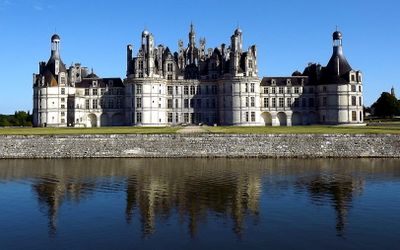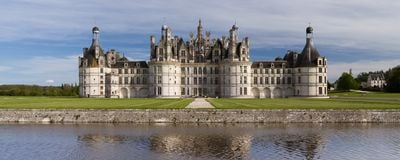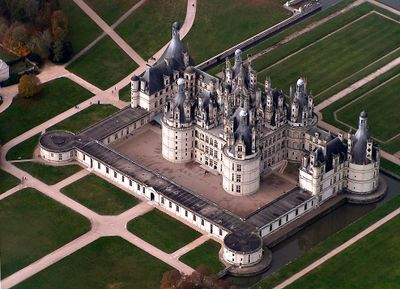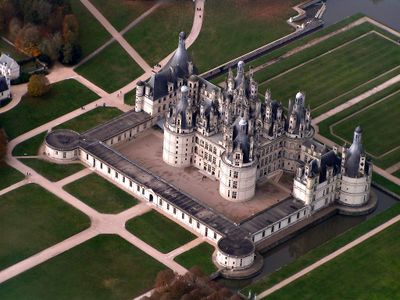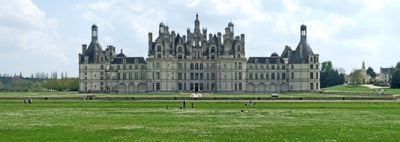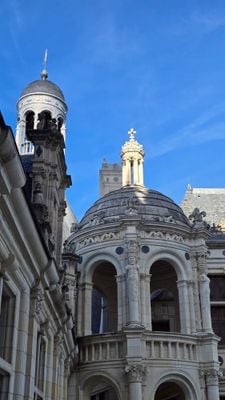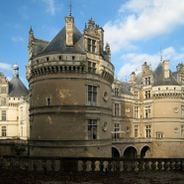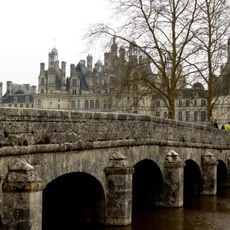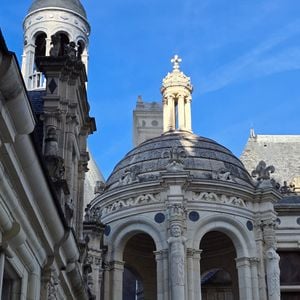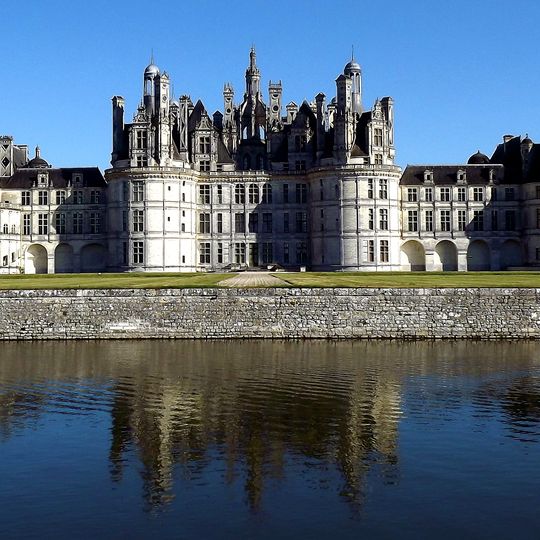
Château de Chambord, Renaissance château in Loire Valley, France
The château features 440 rooms, 282 fireplaces, and 84 staircases spread across its expansive limestone structure in the French Renaissance architectural style.
Construction began in 1519 under Francis I of France as a hunting lodge, with architects Pierre Nepveu and Jacques Sourdeau leading the architectural development until 1547.
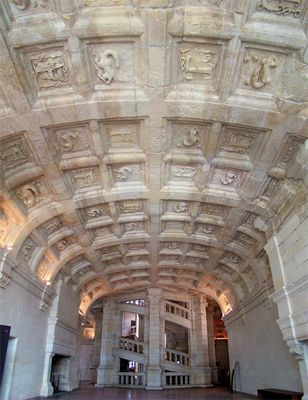
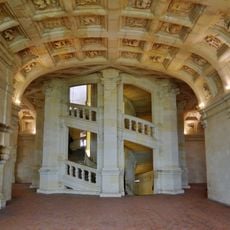
The double helix staircase in the central keep represents a mathematical and architectural innovation that allows two people to ascend without meeting each other.
The château opens its doors every day except January 1st and December 25th, with guided tours available in multiple languages throughout the visiting hours.
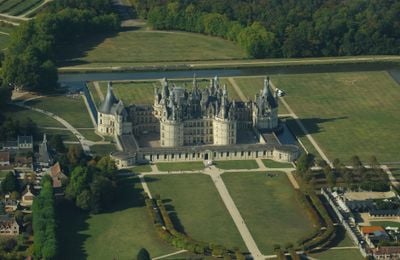
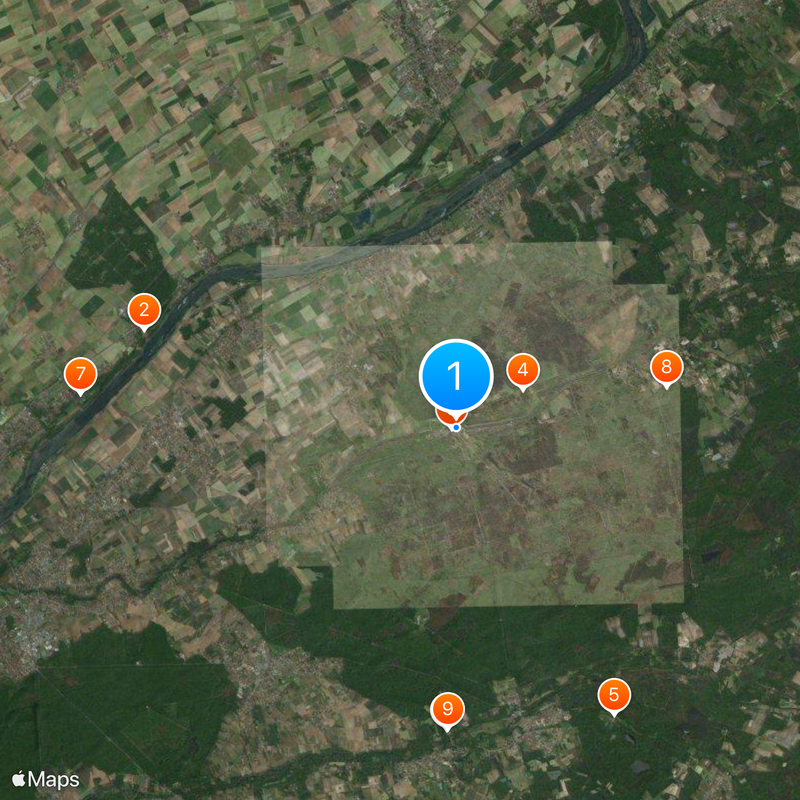
The 5,440-hectare enclosed park contains the largest forest park in Europe surrounded by a 32-kilometer wall housing numerous species of wildlife.
Location: Chambord
Location: Muides-sur-Loire
Location: Neuvy
Location: Saint-Dyé-sur-Loire
Location: Thoury
Location: Tour-en-Sologne
Location: Maslives
Location: Huisseau-sur-Cosson
Inception: 1545
Founders: Francis I of France
Architects: Pierre Nepveu, Jacques Sourdeau
Architectural style: French Renaissance architecture
Part of: Domaine national de Chambord
Opening Hours: January 02-07,March 30-October 27 09:00-18:00; January 08-March 29,October 28-December 31 09:00-17:00; January 1, March 21, December 25 closed
Phone: +33254504000
Website: http://chambord.org
GPS coordinates: 47.61611,1.51722
Latest update: November 13, 2025 15:05
France's historical architecture documents two millennia of construction, from Roman amphitheaters to modern bridge engineering. The structures demonstrate developments in engineering and architecture across multiple periods. The heritage extends from medieval fortifications like Carcassonne and the Fortress of Salses through Gothic cathedrals such as Notre-Dame de Paris and Amiens Cathedral to Renaissance châteaux including Chambord and Chenonceau. Roman engineering persists in the Pont du Gard and the Arena of Nîmes, while the Papal Palace in Avignon and Sainte-Chapelle illustrate medieval political and religious authority. The Loire Valley châteaux and fortified structures like Bonaguil and Pierrefonds demonstrate defensive architecture and aristocratic living. The 20th century brought new perspectives with Le Corbusier's Villa Savoye, a defining work of modern architecture. The Millau Viaduct represents contemporary engineering achievement. Pilgrimage sites like the Basilica of Sainte-Anne-d'Auray and Mont Saint Michel Abbey combine religious significance with architectural skill. These structures provide insight into French history, construction traditions and technical innovation through the centuries.
Medieval castles and fortresses span Europe, documenting defense systems and princely seats from the 9th through 16th centuries. These sites include mountaintop strongholds such as Montségur in the Pyrenees, island fortifications like Trakai in Lithuania, and coastal defenses such as Kronborg in Denmark. Construction methods range from Romanesque towers to late medieval artillery positions, from Moorish palaces like the Alhambra to Gothic defensive structures like Burg Eltz. Many of these sites feature multiple rings of fortifications, underground passages, and residential quarters that provide insights into both military and civil aspects of medieval life. The collection includes locations in varied geographical contexts. Predjama Castle in Slovenia is built into a cliff face, while Eilean Donan in Scotland occupies a tidal island. Fortresses such as Sant Ferran near Figueres demonstrate 18th century military architecture with star shaped bastions. Some sites like Neuschwanstein were constructed in the 19th century in historicist style, combining romantic ideals with engineering advances of their era. Further examples include Château de Chambord in the Loire Valley, Peles Castle in the Carpathian Mountains, and Bojnice in Slovakia. These sites document functions ranging from border fortresses to royal residences and show the evolution of European military architecture across several centuries.
This collection brings together Renaissance masterpieces that dialogue with Leonardo da Vinci's Mona Lisa. From Milan to Florence, passing through European museums, discover works by the greatest masters of this prolific period that shaped art history between the 15th and 16th centuries. Da Vinci's Last Supper in Milan, Raphael's School of Athens at the Vatican, Michelangelo's David in Florence, or Raphael's Sistine Madonna in Dresden testify to the creative genius of this era. The collection also includes sites linked to Leonardo da Vinci, such as the Saint-Hubert Chapel in Amboise where the artist is buried, and the monumental sculpture of Leonardo's Horse at San Siro Racecourse. Each artwork reveals technical innovations, mastery of perspective, and attention to the human figure characteristic of High Renaissance.
France offers diverse winter destinations spanning both urban and natural landscapes. The Alpine regions contain several ski areas, including Chamonix-Mont-Blanc at the base of Western Europe's highest peak, Les Trois Vallées with its extensive network of runs, and L'Alpe d'Huez at elevations above 5,900 feet (1,800 meters). The Aiguille du Midi provides access to high alpine views through a cable car system, while Lake Annecy presents a winter landscape within the Savoie Alps. Cities across the country display their historical architecture during the colder months. Strasbourg Christmas Market transforms the city center into a seasonal gathering place, Nancy presents the 18th-century Place Stanislas, and Paris maintains structures including Sainte-Chapelle and the Jardin du Luxembourg. Beyond the capital, Versailles Palace stands with its formal gardens, Château de Chambord occupies the Loire Valley, and the Palais des Papes remains in Avignon. The Notre-Dame de Reims cathedral shows 13th-century Gothic architecture, while Mont Saint-Michel stays accessible on its tidal island. Additional sites include the Roman-era Nîmes Arena, Pont du Gard, and the medieval fortress of Carcassonne. The Grotte de Lascaux displays prehistoric art, while Les Eyzies de Tayac holds archaeological sites. Southern regions such as the Calanques near Marseille, Gorges du Verdon, Grande Plage in Biarritz, and Cap d'Ail Beach provide access to Mediterranean and Atlantic coastlines, even during winter months.
The Loire River houses castles from French Renaissance and Classical periods. These structures display architectural elements of their time and document noble life. Each castle presents distinct features, from Gothic ornaments to symmetrical gardens. The interiors contain original furniture, tapestries, and art collections.
Château de Villesavin
7.8 km
Parc de Chambord
2 km
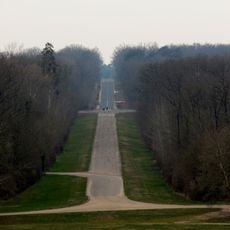
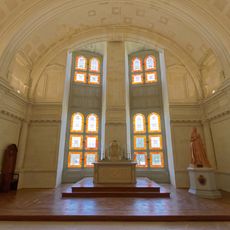
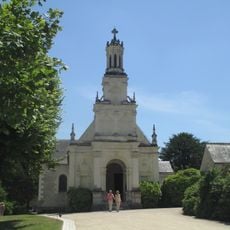
Chapelle du château de Chambord
99 m
Surrounding wall of the national domain of Chambord
5.5 km
Chapelle du château de Villesavin de Tour-en-Sologne
7.7 km
Église Saint-Louis de Chambord
143 m
Château de Colliers
5.5 km
Vieille halle de Bracieux
7.7 km
Pont de Muides-sur-Loire
6.6 km
Château de Cour-sur-Loire
7.8 km
Château de Montlivault
6.1 km
Château de Muides-sur-Loire
5.7 km
Château de la Cressonnière
5.9 km
Église Saint-Vincent-et-Sainte-Radegonde de Cour-sur-Loire
7.8 km
Église Saint-Christophe de Suèvres
7.1 km
Pont Saint-Michel
258 m
Église Saint-Pierre de Montlivault
6.1 km
Église Saint-Lubin de Suèvres
6.9 km
Église Saint-Martin de Crouy-sur-Cosson
7.8 km
Église Saint-Dyé de Saint-Dyé-sur-Loire
5 km
Église Saint-Lubin de Muides-sur-Loire
6.1 km
Église Saint-Claude de Saint-Claude-de-Diray
7.7 km
Église Saint-Étienne de Huisseau-sur-Cosson
5.4 km
Chapelle Saint-My de Huisseau-sur-Cosson
5.4 km
Église de Saint-Nicaise de Bracieux
7.4 km
Château des Forges
6.9 km
Moulin de l'Écuelle
5 km
Château de Nozieux
7.2 kmReviews
Real people, real opinions — but not verified.
Visited this place? Tap the stars to rate it and share your experience / photos with the community! Try now! You can cancel it anytime.
Architectural gem, unmatched!
Magnificent, a park to visit by golf cart or on foot! The castle is worth the detour!
Discover hidden gems everywhere you go!
From secret cafés to breathtaking viewpoints, skip the crowded tourist spots and find places that match your style. Our app makes it easy with voice search, smart filtering, route optimization, and insider tips from travelers worldwide. Download now for the complete mobile experience.

A unique approach to discovering new places❞
— Le Figaro
All the places worth exploring❞
— France Info
A tailor-made excursion in just a few clicks❞
— 20 Minutes