Qesem Cave, Lower Paleolithic cave site near Kafr Qasim, Israel
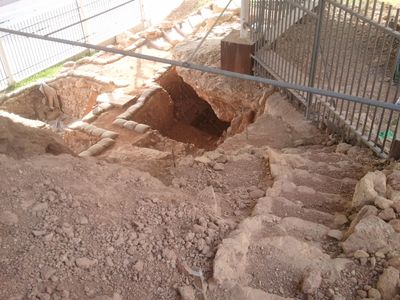
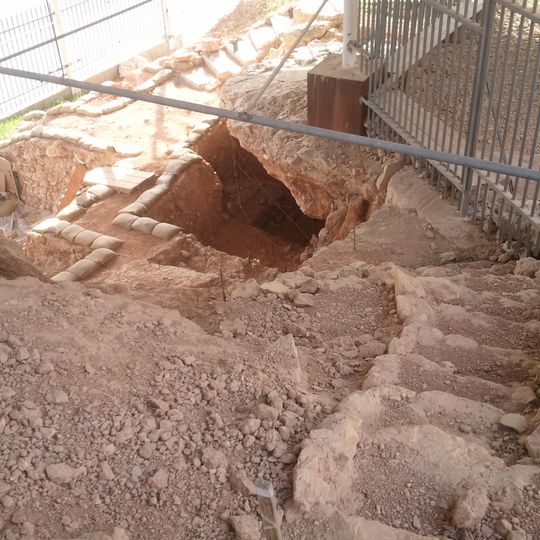
Qesem Cave is a karstic cave in Turonian limestone on the western mountain ridge of Israel, near Kafr Qasim, about 12 km from the Mediterranean and 90 m above sea level. Its deposits are 7.5 m deep, split into an upper layer about 4.5 m thick and a lower layer of 3 m, the upper forming a step on the lower. The cave was found in October 2000 when road construction destroyed its ceiling; the site is now protected, covered and fenced.
The cave was discovered by chance in 2000 during road construction and contains traces of human settlement from hundreds of thousands of years ago. It shows how people returned to this location repeatedly over an extremely long period.
The name Qesem comes from the nearby town of Kafr Qasim. The cave lies in Turonian limestone in the western mountain ridge between the Samaria Hills and the coastal plain, 90 m above sea level and about 12 km from the Mediterranean. Finds belong to the Acheulo-Yabrudian complex, after the Acheulian and before the Mousterian; no Mousterian traces were found.
The cave lies near Kafr Qasim, about 12 km from the Mediterranean coast and 90 m above sea level, in the western mountain ridge between the Samaria Hills and the coastal plain. The site is protected, covered and fenced, and excavations continue, so it is not open for casual visits; access depends on the excavation team. The opening was created in October 2000 when road construction destroyed the cave ceiling.
The cave contains one of the oldest known hearths where early humans regularly used and controlled fire. This find is one of the most important pieces of evidence that our ancestors could manage fire hundreds of thousands of years ago.
The community of curious travelers
AroundUs brings together thousands of curated places, local tips, and hidden gems, enriched daily by 94,087 contributors worldwide.